300+ Science Words That Start With W
Science Words That Start With W are scientific terms that begin with the letter W. These words are used in subjects like physics, chemistry, biology, and astronomy. They help students learn science in a simple and clear way.
Many interesting science words start with the letter W. You may already know words like water, wave, and weather. Learning more W science words makes science easier and more enjoyable.
Science Words That Start With W include both easy and advanced terms. These words explain nature, space, technology, and living things. They also help improve your science knowledge and vocabulary step by step.
Why Do Science Words Starting With W Matter?
Learning science words beginning with W is essential for anyone building a strong foundation in STEM vocabulary. These words appear in textbooks, exams, and everyday conversations about the natural world. When a student understands what work means in physics or what a watershed is in earth science, they can connect classroom theories to the real world around them.
For teachers and ESL learners, science words with W form a core part of science education. These terms are not just academic; they are practical. Understanding weather science helps you plan your day. Knowing about water conservation helps you protect the planet. Mastering this science glossary boosts confidence and opens doors to advanced learning in medicine, technology, and environmental studies.
Physics Science Words That Start With W
Physics helps us understand how the universe moves and behaves. These physics terms starting with W are fundamental for students and enthusiasts building their scientific vocabulary.
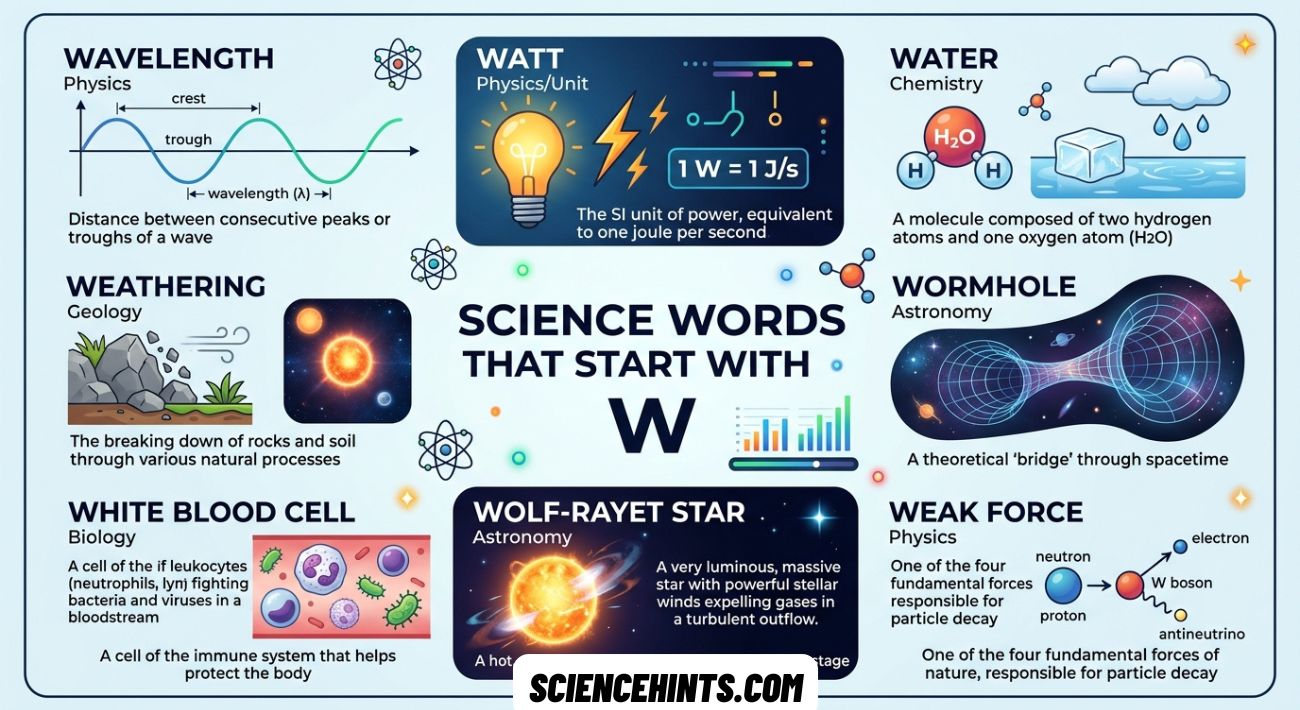
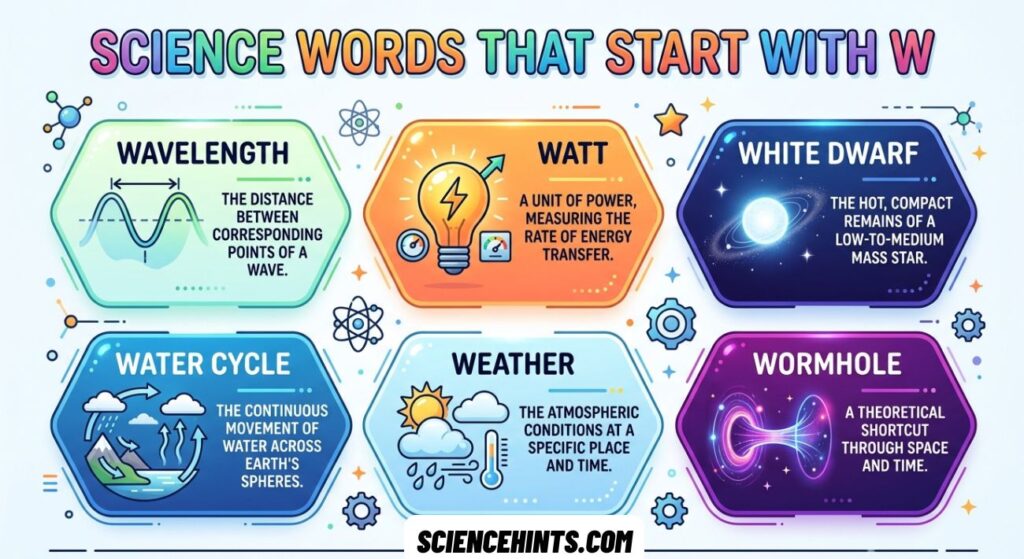
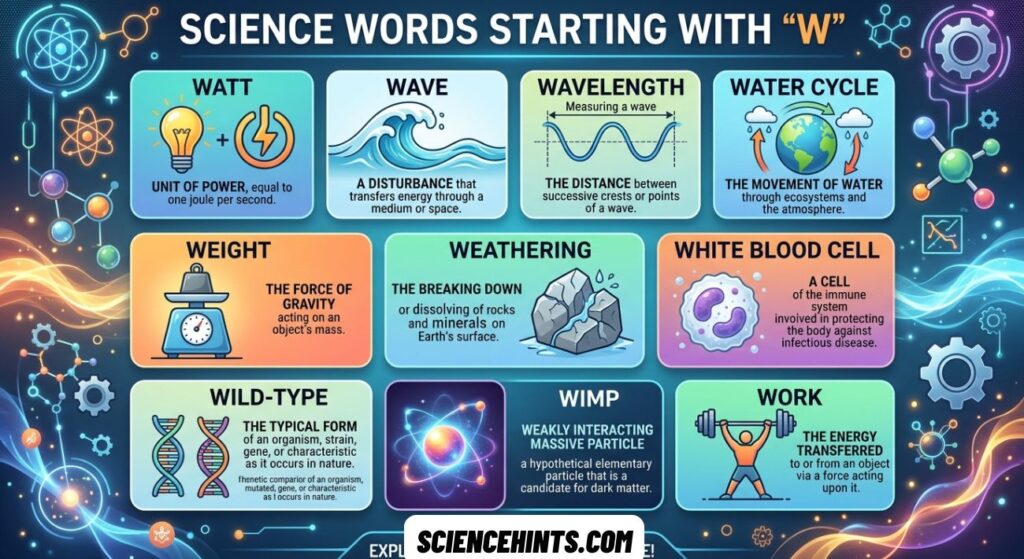
- Watt – The standard unit of power used to measure the rate of energy transfer.
- Work – The energy transferred when a force moves an object over a distance.
- Weight – The force of gravity acting on an object’s mass.
- Wavelength – The distance between two consecutive peaks of a wave.
- Wavefunction – A mathematical description of the quantum state of a particle.
- Weak force – One of the four fundamental forces responsible for radioactive decay.
- Weak interaction – Another name for the weak nuclear force in particle physics.
- Wattmeter – An instrument designed to measure electrical power in watts.
- Work function – The minimum energy needed to remove an electron from a solid surface.
- Wave-particle duality – The concept that every particle exhibits both wave and particle properties.
- White noise – A random signal with equal intensity across all audible frequencies.
- Weber – The SI unit of magnetic flux in electromagnetism.
- W boson – An elementary particle that mediates the weak nuclear force.
- Weightlessness – The sensation experienced when no gravitational force is felt.
- Wave speed – The rate at which a wave crest moves through a medium.
- Wedge – A simple machine made of two inclined planes used to split objects.
- Wheel and axle – A simple machine that amplifies force to move loads easily.
- Wind resistance – The force of air opposing the motion of a moving object.
- Wavenumber – The spatial frequency of a wave, often used in spectroscopy.
- Work-energy theorem – A principle stating work done equals the change in kinetic energy.
Chemistry Science Words That Start With W
Chemistry explores substances and their transformations. These chemistry words starting with W are vital for anyone diving into scientific words that start with W in the lab.
- Water – The universal solvent essential for all known forms of life.
- Weak acid – An acid that does not fully dissociate into ions in a solution.
- Weak base – A base that partially ionizes when dissolved in water.
- Wolfram (tungsten) – The chemical element with the symbol W and atomic number 74.
- Wurtz reaction – A coupling reaction in organic chemistry that combines alkyl halides with sodium.
- Water of crystallization – Water molecules that are chemically bonded inside a crystal structure.
- Wax – A type of organic compound that is malleable and water-repellent.
- Wettability – The ability of a liquid to maintain contact with a solid surface.
- Washing soda – A chemical compound called sodium carbonate used for cleaning.
- Water glass – A soluble silicate compound used as a sealant and adhesive.
- Wohl-Ziegler reaction – A chemical reaction used to brominate alkenes.
- Walden inversion – A reaction where the configuration of a chiral carbon is reversed.
- Wet chemistry – A traditional form of analytical chemistry using liquid reagents.
- Water splitting – The chemical process of breaking water into hydrogen and oxygen.
- Water softening – The removal of calcium and magnesium ions from hard water.
- Water gas – A synthesis gas mixture containing carbon monoxide and hydrogen.
- Wacker process – An industrial method for oxidizing ethylene to acetaldehyde.
- Wurtz-Fittig reaction – A combination reaction mixing alkyl and aryl halides.
- Water hardness – The measure of dissolved mineral content in a water sample.
- Wash bottle – A laboratory squeeze bottle used to rinse glassware with distilled water.
Biology Science Words That Start With W
Biology brings us close to living organisms. These biology words starting with W are key to understanding life and form an important part of any science dictionary.
- Water potential – The potential energy of water that drives its movement in plants.
- White blood cell – A crucial immune cell that fights infection in the body.
- Womb – The muscular organ in female mammals where offspring develop.
- Wild type – The typical form of a species as found in nature, used as a genetic standard.
- Wood – The hard, fibrous structural tissue found in the stems and roots of trees.
- Wildlife – Animals and plants that live and grow in natural, undomesticated conditions.
- W chromosome – The female-determining sex chromosome in birds and some reptiles.
- Warm-blooded – An animal that can regulate its internal body temperature regardless of the environment.
- Wetland – A distinct ecosystem saturated with water, supporting unique aquatic plants.
- Wobble hypothesis – A theory explaining how a single tRNA can recognize multiple codons.
- Wallerian degeneration – The process of nerve fiber breakdown after injury or damage.
- Weismann barrier – The principle that genetic information flows only from germ cells to body cells.
- Wing – A modified forelimb that enables flight in birds, bats, and insects.
- Whiskers – Specialized tactile hairs that help animals sense their surroundings.
- Woody plant – A plant that uses lignin to create rigid, long-lasting stems.
- Water vascular system – A hydraulic system used by echinoderms like starfish for movement.
- Warning coloration – Bright coloring that signals to predators that an animal is toxic.
- Waste product – A substance produced during metabolism that must be excreted.
- Whelping – The act of giving birth in dogs and similar canine species.
- Webbed feet – Feet with skin connecting the toes, aiding in swimming efficiency.
Astronomy & Space Science With W
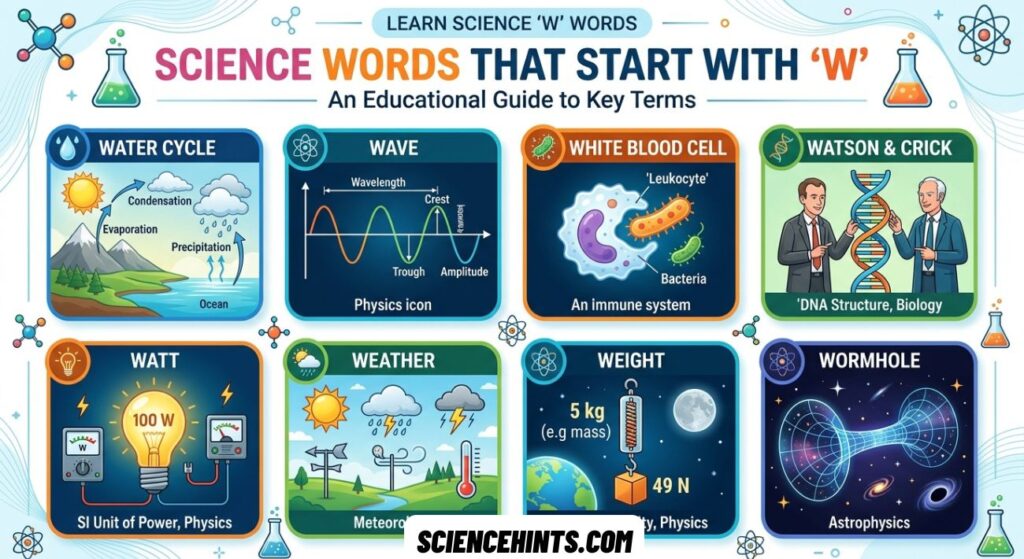
Looking at the stars gives us amazing astronomy words starting with W. These W scientific terms explain the cosmos and the wonders of space exploration.
- White dwarf – The dense, hot stellar remnant left after a star exhausts its nuclear fuel.
- Wormhole – A hypothetical tunnel through spacetime linking two distant points in the universe.
- Waxing moon – The phase when the visible portion of the moon is growing larger.
- Waning moon – The phase when the illuminated surface of the moon appears to shrink.
- Wolf-Rayet star – A massive, highly luminous star that is shedding its outer layers rapidly.
- WMAP – A NASA satellite that mapped the cosmic microwave background radiation of the universe.
- WIMP – A hypothetical weakly interacting massive particle considered a candidate for dark matter.
- Widmanstätten pattern – Unique crystalline structures found in certain iron-nickel meteorites.
- Winter solstice – The shortest day of the year marking the official start of winter in the Northern Hemisphere.
- Wavelength – The measure of light waves that determines their color and energy in the electromagnetic spectrum.
- Weightlessness – The microgravity condition experienced by astronauts in orbit around Earth.
- Warm ionized medium – A diffuse, hot component of the interstellar medium.
- Water ice – The solid form of water found on moons, comets, and polar craters of planets.
- Wolf number – A count used to track solar activity by measuring sunspots.
- Wobble method – A technique used to detect exoplanets by measuring a star’s slight movement.
- White hole – A hypothetical cosmic object that ejects matter and light, the opposite of a black hole.
- Weather satellite – An artificial satellite designed to monitor Earth’s weather and climate from orbit.
- Waxing gibbous – The lunar phase between the first quarter and the full moon.
- Waning crescent – The final lunar phase before the cycle resets to the new moon.
- Westerlund 2 – A massive young star cluster located in the Milky Way galaxy.
See Also : 330+ Science Words That Start With F
Earth & Environmental Science Words Starting With W
Our planet is a dynamic system of air, land, and water. These earth science words with W and environmental science terms help us become better stewards of the environment.
- Weather – The short-term state of the atmosphere, including temperature, humidity, and wind.
- Water cycle – The continuous movement of water through evaporation, condensation, and precipitation.
- Water table – The underground boundary where soil and rock become fully saturated with water.
- Watershed – A land area that channels all rainfall and snowmelt to a single outflow point.
- Weathering – The breakdown of rocks and minerals on the Earth’s surface by natural forces.
- Wind erosion – The transportation and removal of surface soil by strong wind currents.
- Wind – The horizontal movement of air caused by atmospheric pressure differences.
- Water resources – The available supplies of surface and groundwater for human use.
- Water pollution – The contamination of water bodies by harmful chemicals or microorganisms.
- Water conservation – The careful management and preservation of fresh water resources.
- Water quality – The chemical, physical, and biological characteristics of a water source.
- Wildfire – An uncontrolled, rapidly spreading fire in wildland vegetation and forests.
- Warm front – A boundary where a warm air mass slides over a retreating cold air mass.
- Wind chill – The perceived decrease in temperature felt by the human body due to wind.
- Waste management – The collection and disposal of garbage, sewage, and other waste products.
- Wetland restoration – The process of returning damaged or lost wetland ecosystems to their original state.
- Water vapor – The gaseous phase of water present in the Earth’s atmosphere.
- Wind farm – A group of wind turbines generating electricity in a single location.
- Weather map – A visual representation of meteorological conditions across a geographic area.
- Water footprint – The total volume of freshwater used to produce goods and services consumed.
Medical & Health Science Words That Start With W
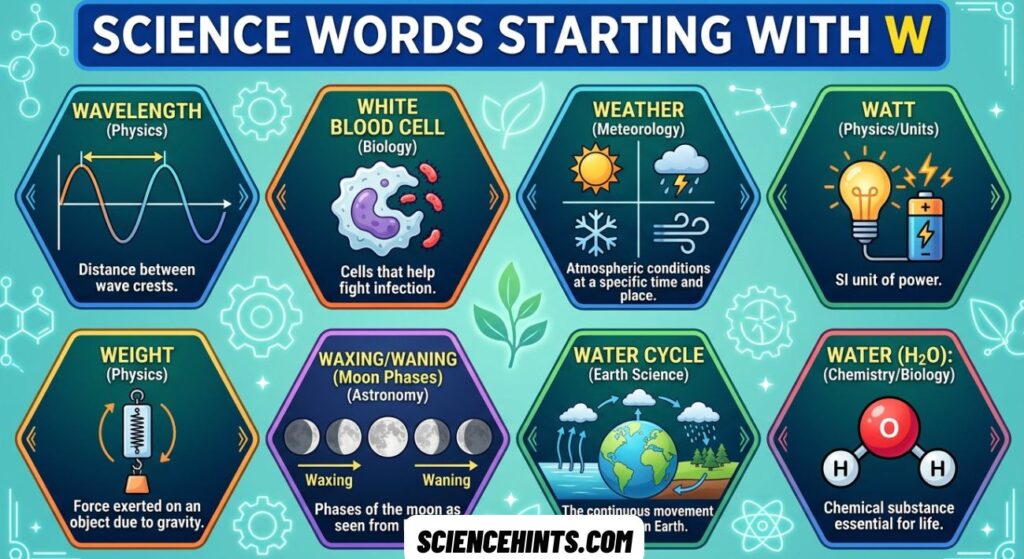
The medical field uses precise language to describe the body and its conditions. These medical science words are essential examples of scientific vocabulary with W.
- Wart – A small, benign skin growth caused by the human papillomavirus.
- Western blot – A laboratory technique used to detect specific protein molecules in a tissue sample.
- White matter – Brain tissue composed of nerve fibers that connect different gray matter areas.
- Wheezing – A high-pitched whistling sound produced during breathing due to narrowed airways.
- Whooping cough – A highly contagious bacterial infection causing severe coughing fits, also called pertussis.
- Wound – A physical injury to the body involving a break in the skin or tissue.
- Womb – The hollow, pear-shaped organ where a fetus grows during pregnancy.
- Water retention – The buildup of excess fluid in the body’s circulatory system and tissues.
- Washout period – The time required for a drug to be fully eliminated from the body during a clinical trial.
- Wandering spleen – A rare medical condition where the spleen moves from its normal position.
- Weil’s disease – A severe form of leptospirosis infection causing jaundice and kidney damage.
- Wiskott-Aldrich syndrome – A rare genetic immunodeficiency disorder affecting blood cells.
- Weight-bearing exercise – Physical activity that forces muscles to work against gravity while standing.
- White coat hypertension – A temporary spike in blood pressure when visiting a medical clinic.
- Worm infestation – A parasitic condition where helminths inhabit the gastrointestinal tract.
- Water-soluble vitamin – A vitamin that dissolves in water and is not stored in large amounts by the body.
- Waddling gait – A distinctive walking pattern often associated with muscle weakness.
- Wedge fracture – A compression fracture of a vertebra causing a triangular deformity.
- WBC differential – A blood test counting the different types of white blood cells present.
- Warfarin – A commonly prescribed anticoagulant medication used to prevent blood clots.
Technology & Applied Science Words With W
Modern life runs on technology defined by these technology science words. These W scientific terms power the digital world and engineering marvels.
- Wi-Fi – A wireless networking technology using radio waves for high-speed internet connectivity.
- Wearable technology – Smart electronic devices designed to be worn on the user’s body.
- Wireless charging – The transmission of electrical power from a pad to a device without a physical cable.
- Wind turbine – A mechanical device that converts the kinetic energy of wind into electrical power.
- Web server – A computer system storing and delivering web page content to users online.
- Workflow – A defined sequence of automated tasks and business processes in software systems.
- WAN – A Wide Area Network spanning large geographic distances between connected computers.
- Watermark – A recognizable digital overlay used to protect intellectual property in media files.
- WYSIWYG – A software editor displaying content exactly as it will appear in the final output.
- Wattage – The measure of electrical power consumption for a specific appliance or device.
- Web crawler – An automated script that systematically browses the internet to index web pages.
- White paper – An authoritative technical document solving a specific problem or explaining a technology.
- Wireframe – A low-fidelity visual guide representing the skeletal structure of a website or app.
- Wired network – A data connection system relying on physical Ethernet cables rather than radio signals.
- Widget – A small, standalone application element placed on a screen for quick access to tools.
- Wind load – The force exerted by wind on a structure, crucial for safe building design.
- Water cooling – A method of removing heat from computer processors using liquid coolant.
- Waveform – The graphic representation of a sound signal’s shape as it varies over time.
- Webhook – An automated message sent from one application to another when a specific event triggers.
- Workstation – A high-performance computer designed for technical, engineering, or scientific applications.
Easy Science Words That Start With W
These are simple and fun easy science words with W perfect for beginners and young students building their scientific vocabulary for students.
- Water – A clear liquid essential for drinking and living things to survive.
- Wind – Moving air that you can feel on a breezy day outside.
- Warm – Having a comfortable degree of heat that is not too hot.
- Wet – Covered or saturated with water or another liquid.
- Wave – A curling bump moving across the surface of the ocean or a lake.
- Web – A sticky net made by a spider to catch its food.
- Wing – The body part of a bird, bat, or insect that allows it to fly.
- White – The brightest color, reflecting all rays of visible light.
- Winter – The coldest season of the year, falling between autumn and spring.
- Weather – What the sky and air feel like outside, such as sunny or rainy.
- Wood – The solid material that forms the trunk and branches of a tree.
- Wild – An animal or plant living in nature without human care or control.
- Worm – A small, soft-bodied creature living in soil that helps to break down dead leaves.
- Whiskers – The long stiff hairs near an animal’s nose used for feeling things.
- Waterfall – A steep flow of river water falling from a high rocky ledge.
- Walrus – A large marine mammal with tusks and whiskers living in the Arctic.
- Wasp – A flying insect with a narrow waist and a painful sting for defense.
- Wool – The soft, thick hair covering sheep used for making warm clothes.
- Wildflower – A flower that grows freely without being planted by people.
- Wax – A solid, shiny substance used in candles and for polishing surfaces.
Advanced & Technical Science Words With W
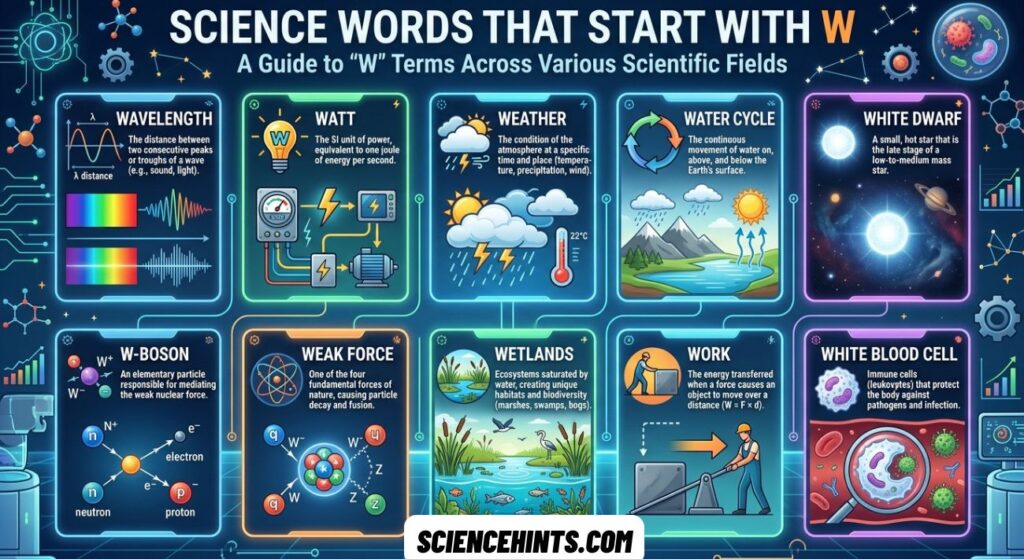
For college students and professionals, these advanced science terms with W represent deep concepts. Mastering this science terminology sets you apart in STEM vocabulary.
- Warburg effect – A metabolic hallmark where cancer cells favor glycolysis over respiration even with oxygen.
- Wentzel-Kramers-Brillouin approximation – A quantum mechanical method for solving linear differential equations.
- Weissenberg effect – A fluid dynamics phenomenon where viscoelastic liquids climb up a rotating rod.
- Wolff-Chaikoff effect – An autoregulatory phenomenon where excess iodide temporarily inhibits thyroid hormone synthesis.
- Wigner effect – The displacement of atoms in a solid caused by neutron radiation exposure.
- Westergren method – A standard laboratory technique for measuring erythrocyte sedimentation rates.
- Windkessel effect – The elastic expansion of large arteries that smooths out pulsatile blood flow.
- Wurtzite – A zinc sulfide crystal structure found in certain semiconductors and minerals.
- Weinberg angle – A fundamental mixing angle in the electroweak theory of particle physics.
- Wolfram language – A high-level computational programming language powering Mathematica software.
- Weld decay – A form of intergranular corrosion occurring near a weld joint in stainless steel.
- Wien’s displacement law – A physics law stating the thermal radiation peak wavelength inversely relates to temperature.
- Widom line – The dynamic crossover line extending the vapor-liquid critical point in supercritical fluids.
- Woodward-Hoffmann rules – A set of orbital symmetry rules predicting activation energies in pericyclic reactions.
- Wigner-Seitz cell – A primitive unit cell in a crystal lattice built around a single lattice point.
- Wadati-Benioff zone – A deep active seismic zone dipping beneath an overriding tectonic plate.
- Wilzbach method – A technique for labeling organic compounds with tritium for tracing studies.
- Wallace’s line – A faunal boundary separating the distinct ecozones of Asia and Australia.
- Wadell’s sphericity – A measure of how closely the shape of a particle approximates a perfect sphere.
- Wobbe Index – A measure of the interchangeability of fuel gases for combustion equipment.
Scientific Instruments & Tools That Start With W
Every laboratory and field study relies on precision instruments. These scientific words that start with W describe tools used daily by researchers and engineers across various disciplines.
- Wattmeter – A device that measures the electric power in watts flowing through a circuit.
- Weather balloon – A high-altitude balloon carrying instruments to measure atmospheric conditions.
- Wind vane – A simple instrument that shows the direction the wind is blowing.
- Water bath – A laboratory container filled with heated water used to incubate samples gently.
- Watch glass – A circular, concave glass dish used to hold solids or evaporate liquids.
- Weighing scale – A precise instrument for measuring the mass of an object or substance.
- Wave tank – A shallow tank of water used to study the behavior of mechanical waves.
- Wind tunnel – A large tube with moving air used to test aerodynamic properties of objects.
- Water sampler – A device that collects water from specific depths in oceans or lakes.
- Wet bulb thermometer – A thermometer wrapped in a wet cloth to measure humidity levels.
- Wheatstone bridge – An electrical circuit used to measure unknown resistance with high accuracy.
- Wavemeter – An instrument that measures the wavelength of an electromagnetic signal.
- Water level indicator – A sensor that detects and displays the height of water in a tank.
- Webcam – A digital camera that streams live video for scientific observation and monitoring.
- Wardian case – A sealed protective glass container used historically to transport live plants.
- Wind profiler – A Doppler radar system that measures vertical wind speed and direction.
- Well counter – A device used in nuclear medicine to measure radioactive samples in test tubes.
- Water distiller – An apparatus that purifies water through the process of boiling and condensation.
- Wound retractor – A surgical tool used to hold back tissue edges during medical operations.
- Wrist goniometer – An instrument that measures the range of motion in the wrist joint.
See Also : 300+ Science Words That Start With R
Scientists & Pioneers With W Names In Science
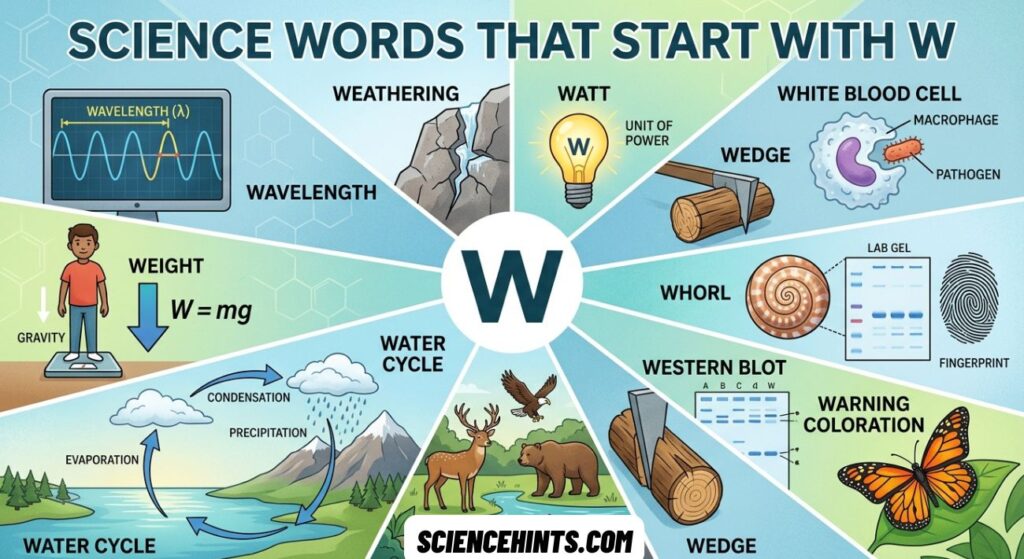
Behind every great discovery stands a curious mind. These W science words honor the influential scientists whose names became part of the permanent science terminology we use today.
- James Watt – The Scottish engineer who improved the steam engine and gave his name to the unit of power.
- Alfred Wegener – The German scientist who proposed the groundbreaking theory of continental drift.
- Wilhelm Wundt – The father of modern experimental psychology and scientific study of the mind.
- Maurice Wilkins – The Nobel laureate whose work helped reveal the structure of DNA.
- Norbert Wiener – The mathematician who founded the field of cybernetics and systems theory.
- Steven Weinberg – The theoretical physicist who unified electromagnetism and the weak nuclear force.
- Werner Heisenberg – The pioneer of quantum mechanics famous for the uncertainty principle.
- Thomas Hunt Morgan – The biologist who used fruit flies to prove chromosomes carry genes.
- August Weismann – The evolutionary biologist who proposed the germ plasm theory of heredity.
- Wilhelm Röntgen – The physicist who discovered X-rays and won the very first Nobel Prize in Physics.
- Carl Woese – The microbiologist who discovered the third domain of life called Archaea.
- Eugene Wigner – The theoretical physicist who laid foundations for symmetries in quantum mechanics.
- William Harvey – The English physician who first correctly described blood circulation in the body.
- John Wheeler – The theoretical physicist who popularized the term black hole in cosmology.
- Wilhelm Ostwald – The chemist recognized for his pioneering work in catalysis and chemical equilibria.
- John B. Watson – The psychologist who established the behaviorist school of thought.
- Robert Whittaker – The ecologist who proposed the five-kingdom classification system for organisms.
- Sewall Wright – The geneticist who developed mathematical population genetics and evolutionary theory.
- Friedrich Wöhler – The chemist who synthesized urea, disproving the theory of vitalism in biology.
- Wilbur Wright – The aviation pioneer who co-invented the first successful powered airplane.
Mathematical Science Words That Start With W
Mathematics is the universal language of logic. These scientific terms with W are essential for students building a strong foundation in STEM vocabulary and problem-solving skills.
- Whole number – A basic counting number that is not a fraction, decimal, or negative value.
- Width – The straight measurement across something from one side to the other side.
- Weighted average – A mean calculated by assigning different levels of importance to each value.
- Wedge product – An antisymmetric algebraic operation used in exterior algebra and differential geometry.
- Weierstrass function – A classic example of a continuous function that is nowhere differentiable.
- Well-defined – A mathematical expression where the definition produces a single, unambiguous result.
- Wronskian – A determinant used to test the linear independence of a set of functions.
- Wilcoxon test – A non-parametric statistical test comparing paired samples without normal distribution.
- Weibull distribution – A continuous probability distribution used in reliability engineering and survival analysis.
- Weak convergence – A type of limit where a sequence of vectors converges in a distributional sense.
- Weight function – A mathematical function used to give specific elements more influence in a sum.
- Winding number – An integer representing the total number of times a curve wraps around a point.
- Wavelet transform – A mathematical tool that breaks data into scaled and shifted versions of a mother wavelet.
- Wiener process – A continuous-time stochastic process that models random movement, called Brownian motion.
- Wald test – A statistical method used to test the true value of a parameter in a model.
- Weak solution – A generalized solution to a differential equation that satisfies an integral formulation.
- Whitney extension theorem – A result describing when a function can be extended smoothly from a closed set.
- Wedge sum – A topological construction that glues together points from different spaces into one.
- Waring’s problem – A number theory question about expressing integers as sums of powers.
- Woodbury matrix identity – A formula for efficiently inverting a matrix that has undergone a low-rank update.
Psychology & Cognitive Science Words With W
The human mind is a complex system worthy of study. These science words beginning with W explore mental processes, emotions, and behavior within science education.
- Working memory – The brain’s short-term storage system that actively processes and manipulates information.
- Willpower – The mental ability to resist short-term temptations to achieve long-term goals.
- Wakefulness – The state of being alert and conscious, regulated by the brain’s arousal system.
- Withdrawal – The physical and psychological symptoms that occur when stopping an addictive substance.
- Well-being – A positive state of mental health, life satisfaction, and emotional balance.
- Weber’s law – A principle stating that noticeable change in a stimulus is proportional to its original intensity.
- Wernicke’s area – The brain region responsible for the comprehension of spoken and written language.
- Working alliance – The collaborative and trusting relationship between a therapist and a client.
- Word association – A psychological test where a person says the first word that comes to mind.
- Wish fulfillment – The Freudian concept that dreams represent unconscious desires and repressed wishes.
- Weapon focus effect – A memory phenomenon where a witness fixates on a weapon, forgetting other details.
- Wandering mind – The cognitive state when attention drifts away from the current task to unrelated thoughts.
- Warm glow effect – The emotional reward people feel after performing an altruistic or generous act.
- Wisdom – The complex trait combining life experience, emotional regulation, and deep reflective judgment.
- Worry – A repetitive chain of negative thoughts about potential future threats or problems.
- Work-life balance – The mental equilibrium between professional responsibilities and personal life fulfillment.
- Witness memory – The recollection of events by an observer, studied extensively in forensic psychology.
- Wechsler scale – A standardized intelligence test widely used to measure cognitive ability in adults and children.
- Wake therapy – A treatment for depression involving controlled sleep deprivation to reset the mood cycle.
- Word superiority effect – The phenomenon where letters are recognized faster when presented within a real word.
Materials Science & Engineering Words Starting With W
Materials shape the world around us. These advanced science terms with W describe the properties and processes that engineers use to build everything from skyscrapers to smartphones.
- Weldability – The ability of a metal or material to be fused together by heating under specific conditions.
- Work hardening – The strengthening of a metal by repeatedly bending or deforming it plastically.
- Wear resistance – A material’s ability to withstand surface damage caused by friction or abrasion.
- Wire drawing – A manufacturing process that pulls metal through a die to reduce its diameter.
- Wood composite – An engineered panel made from wood fibers, particles, or veneers bonded with adhesive.
- Water absorption – The amount of moisture a material can take up from its surrounding environment.
- Warpage – An unintended bend or twist in a part caused by uneven cooling or internal stress.
- Weibull modulus – A statistical measure describing the variability in fracture strength of brittle materials.
- Whisker (metal) – A tiny, hair-like crystalline filament that grows spontaneously on metallic surfaces.
- Weathering steel – A high-strength alloy that forms a stable rust-like protective outer coating.
- Wrought iron – A tough, malleable form of iron with a very low carbon content and fibrous slag inclusions.
- Weld bead – The deposited filler metal that forms a single pass of welding along a joint.
- Water jet cutting – A process using a high-pressure stream of water to slice through hard materials.
- Wave soldering – A bulk soldering technique used to attach electronic components to printed circuit boards.
- White cast iron – A hard, brittle iron containing carbide impurities that fracture along a white surface.
- Wool fiber – A natural protein fiber obtained from sheep fleece valued for its insulation and elasticity.
- Wet lay-up – A composite fabrication method where liquid resin is applied to reinforcing fibers by hand.
- Wide flange beam – An H-shaped structural steel section used extensively in building construction framing.
- Wall thickness – The measure of how thick a pipe or hollow structural tube wall is at any point.
- Wire rope – A strong, flexible cable made of multiple strands of steel wire twisted around a central core.
Fun Facts About Science Words That Starting W
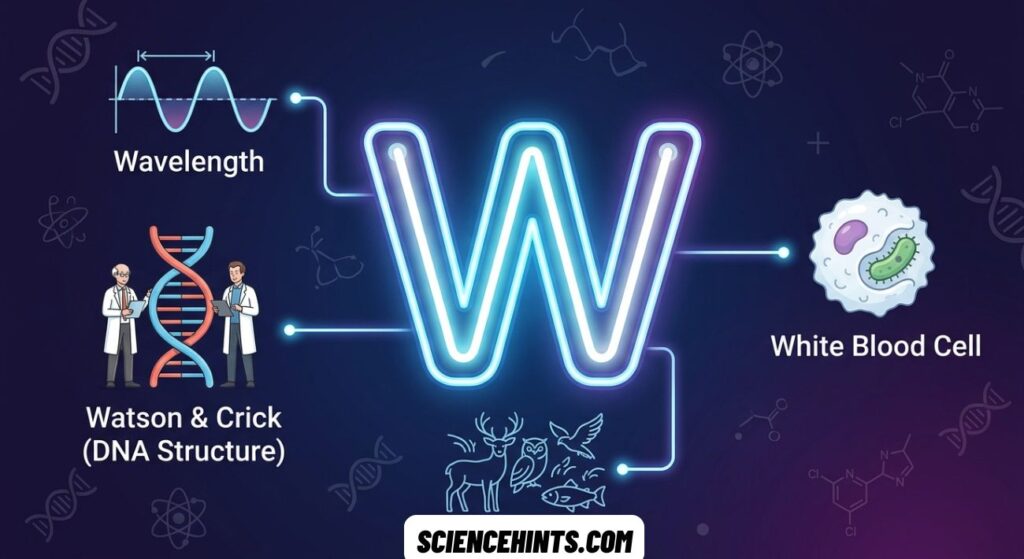
Science is full of surprises. The letter W hides some of the most interesting stories in the science glossary, making these W science words fun to learn and remember.
The symbol for Tungsten is W, but it comes from the German word Wolfram. This means “wolf’s foam,” named because miners believed the mineral ate away at tin like a hungry wolf. In another quirky twist, the chemical name water is one of the few substances we encounter daily as a solid, liquid, and gas. It is the most important of all scientific terms with W.
Did you know a white dwarf star is so dense that a teaspoon of it would weigh as much as a car? In the medical world, the Western blot test is not a writing test but a life-saving protein detection method. Also, the water cycle has been recycling the same water molecules for billions of years, meaning you might drink the same water a dinosaur did. These fun facts make learning science words beginning with W a memorable experience for any science enthusiast.
Comparing Simple vs. Advanced Science Words That Start With W
| Simple Science Word | Simple Definition | Related Advanced Term | Advanced Definition |
|---|---|---|---|
| Water | A clear liquid we drink. | Water potential | Energy driving water movement in plants. |
| Wind | Moving air outside. | Wind erosion | Transport of soil particles by air. |
| Warm | Having heat. | Warm ionized medium | Hot, diffuse gas component in space. |
| Wave | A bump moving on water. | Wavefunction | Mathematical state of a quantum particle. |
| White | The lightest color. | White dwarf | Dense remnant of a dead star. |
| Web | A spider’s trap. | Web server | Computer hosting internet web pages. |
| Wing | Bird part for flying. | Wing loading | Aircraft weight divided by wing area. |
| Wet | Covered with liquid. | Wet chemistry | Traditional lab analysis using liquids. |
Frequently Asked Questions
What does W stand for in physical science?
In physical science, W stands for watt, the SI unit of power. It also represents work and wavelength in different scientific contexts.
What are 10 words that start with W?
Water, Wave, Wavelength, Watt, Weight, Weather, Work, Wildlife, Wetland, White Dwarf.
What is a chemistry term that starts with W?
A common chemistry term that starts with W is Water (H₂O), the universal solvent essential for life. Another important term is Weak Acid, which only partially ionizes in water.
What are 10 science words?
Atom, Cell, Energy, Force, Gravity, Molecule, Neutron, Orbit, Spectrum, Water.
Conclusion
Science Words That Start With W help students build a strong science vocabulary. These words explain many ideas in physics, chemistry, biology, astronomy, and environmental science. Simple terms like water, wave, and weather make learning easier. Advanced words help students understand more difficult topics as they grow. Learning these words improves reading, writing, and speaking in science. It also helps students understand textbooks, classroom lessons, and science activities with greater confidence.
Science Words That Start With W are useful for learners of every age. They make scientific ideas clear and easy to remember. Regular practice with these words builds knowledge step by step. Students can use them in school projects, assignments, and daily learning. A strong science vocabulary also supports better communication and critical thinking. Keep learning new W science words and review them often. Every new word adds to your understanding of science and helps you enjoy discovering the world around you.