300+ Science Words That Start With S – A Complete A-Z Glossary for Students & Enthusiasts
Science Words That Start With S are scientific terms that begin with the letter S. These words help explain ideas in science. Students use them to learn science in a simple and clear way.
Many important science words start with the letter S. They are used in biology, chemistry, physics, and space science. Learning these words makes science more interesting and easier to understand.
Science Words That Start With S include easy and advanced scientific terms. These words describe living things, materials, energy, and nature. They also help improve science vocabulary and learning skills.
Why Science Words That Start With S Matter
Building a strong science vocabulary is essential for success in school, college, and beyond. When students master scientific vocabulary early, they gain confidence in reading textbooks, writing lab reports, and understanding complex science concepts. The letter S covers foundational ideas like the solar system, sound, species, and solution, making it one of the most important letters in any science dictionary.
For teachers and ESL learners, a well-organized science glossary saves time and makes learning more effective. These science word meanings connect everyday language to scientific language, helping learners of all ages grasp STEM vocabulary faster. Mastering these words beginning with S builds real-world knowledge that supports science education and prepares students for careers in medicine, engineering, and research.
Physics Science Words That Start With S
Physics is the study of matter, energy, and the fundamental forces of nature. These physics terms starting with S are essential for understanding motion, electricity, and quantum mechanics.
- Scalar – A physical quantity that has only magnitude and no direction.
- Speed – The rate at which an object covers distance over time.
- Superconductivity – The property of zero electrical resistance in certain materials at very low temperatures.
- Superposition – A quantum mechanics principle where a particle exists in multiple states at once until measured.
- Sound – A vibration that travels through a medium as a mechanical wave.
- Static electricity – The buildup of electric charge on the surface of an object.
- Solenoid – A coil of wire that produces a magnetic field when electric current flows through it.
- Symmetry – A property where a system remains unchanged under certain transformations.
- Scattering – The redirection of particles or waves when they hit an obstacle.
- Specific heat – The amount of heat required to raise the temperature of one gram of a substance by one degree Celsius.
- Stress – The internal force per unit area within a material.
- Strain – The deformation of a material caused by applied stress.
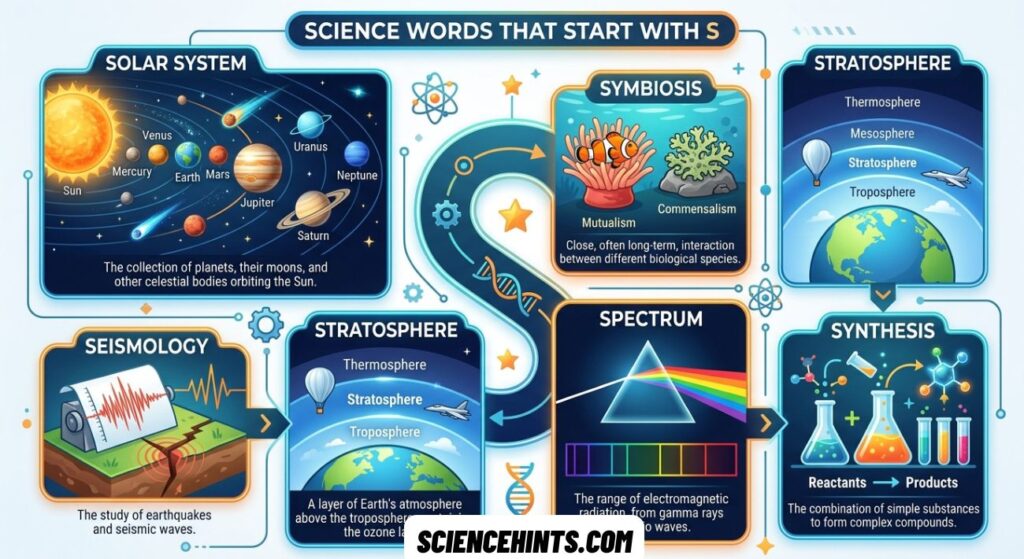
- Spectrum – The range of wavelengths of electromagnetic radiation.
- Spin – The intrinsic angular momentum of elementary particles.
- Superfluidity – A phase of matter with zero viscosity and infinite thermal conductivity.
- Spintronics – A field of electronics that uses the spin of electrons for data processing.
- Synchrotron – A particle accelerator that produces intense beams of light for research.
- Subatomic – Relating to particles smaller than an atom.
- Surface tension – The elastic tendency of liquid surfaces to shrink into the minimum area.
- Stochastic – A process involving random probability distributions.
Chemistry Science Words That Start With S
Chemistry explores the composition, structure, and reactions of matter. These chemistry words starting with S include fundamental lab terms and reaction types.
- Solution – A homogeneous mixture of two or more substances.
- Solute – The substance that dissolves in a solvent to form a solution.
- Solvent – The substance that dissolves a solute to form a solution.
- Saturated solution – A solution that cannot dissolve any more solute at a given temperature.
- Supersaturated solution – A solution containing more dissolved solute than normally possible at a given temperature.
- Solubility – The maximum amount of a substance that can dissolve in a solvent.
- Sublimation – The phase transition from solid directly to gas without passing through liquid.
- Synthesis – A reaction where simple substances combine to form a more complex product.
- Salt – An ionic compound formed from the neutralization reaction of an acid and a base.
- Stoichiometry – The calculation of reactant and product quantities in chemical reactions.
- Sulfur – A yellow nonmetal element with atomic number 16.
- Solvation – The process of surrounding solute particles with solvent molecules.
- Solidification – The phase change from liquid to solid.
- Stereochemistry – The study of the three-dimensional arrangement of atoms in molecules.
- Stereoisomerism – A form of isomerism where molecules have the same formula but different spatial arrangements.
- Strong acid – An acid that completely dissociates in water.
- Strong base – A base that completely dissociates in water.
- Surfactant – A compound that lowers surface tension between two liquids or a liquid and a solid.
- Spectroscopy – The study of matter-radiation interaction based on wavelength.
- Standardization – The process of determining the exact concentration of a solution.
Biology Science Words That Start With S
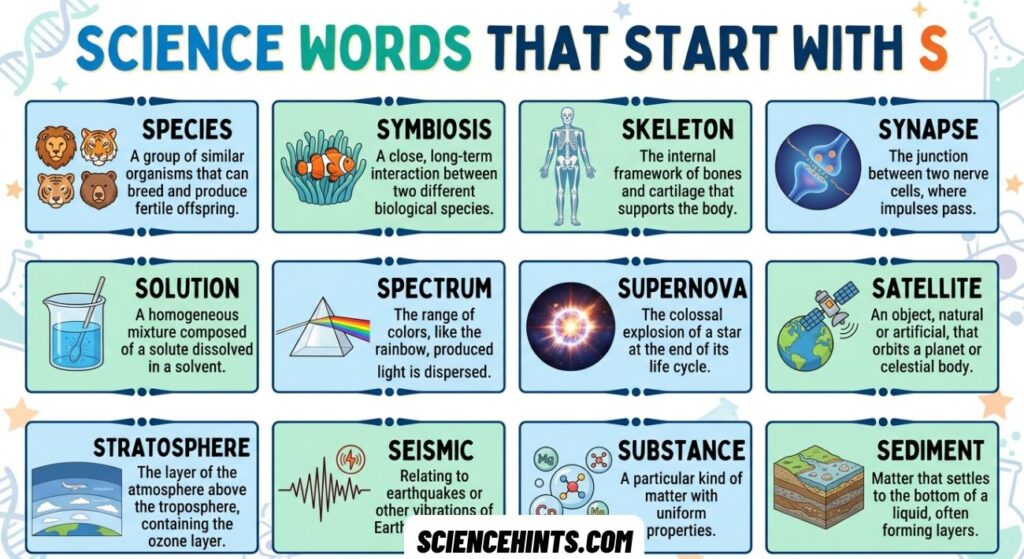
Biology is the study of living organisms and life processes. These biology words starting with S cover cells, genetics, and ecosystems.
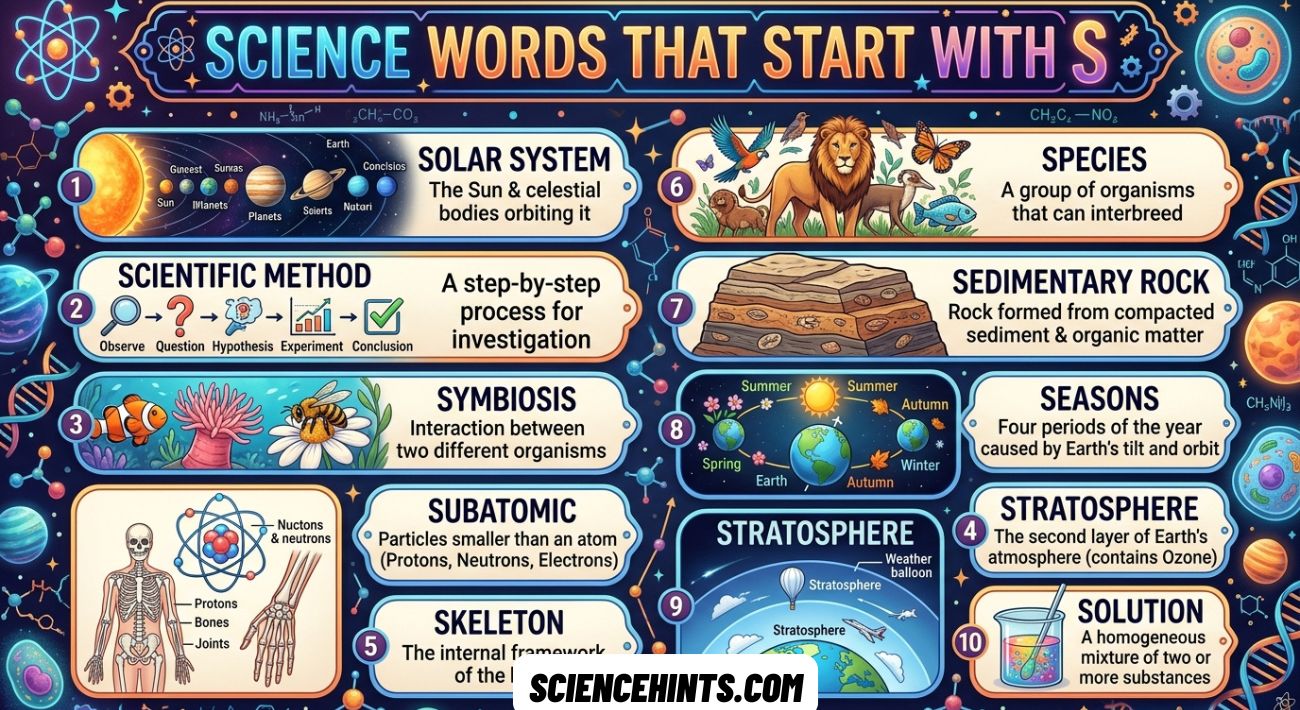
- Species – A group of organisms capable of interbreeding and producing fertile offspring.
- Symbiosis – A close long-term interaction between two different biological species.
- Stimulus – A detectable change in the environment that triggers a response in an organism.
- Spore – A reproductive cell capable of developing into a new organism without fusion.
- Skeleton – The structural framework that supports and protects an organism’s body.
- Stomata – Tiny pores on plant leaves that allow gas exchange.
- Stem cell – An undifferentiated cell capable of developing into specialized cell types.
- Synapse – The junction between two nerve cells where signals are transmitted.
- Serotonin – A neurotransmitter that regulates mood, sleep, and appetite.
- Sperm – The male reproductive cell in sexual reproduction.
- Somatic cell – Any body cell other than reproductive cells.
- Secretion – The release of substances from cells or glands.
- Spinal cord – The bundle of nerves running from the brain down the vertebral column.
- Semipermeable – Allowing certain molecules to pass through while blocking others.
- Signal transduction – The process by which a cell converts an external signal into a response.
- Substrate – The surface or material on which an organism lives or an enzyme acts.
- Saprophyte – An organism that feeds on dead and decaying organic matter.
- Stamen – The male reproductive organ of a flower.
- Sepal – The outer leaf-like part of a flower that protects the bud.
- Speciation – The evolutionary process by which new biological species arise.
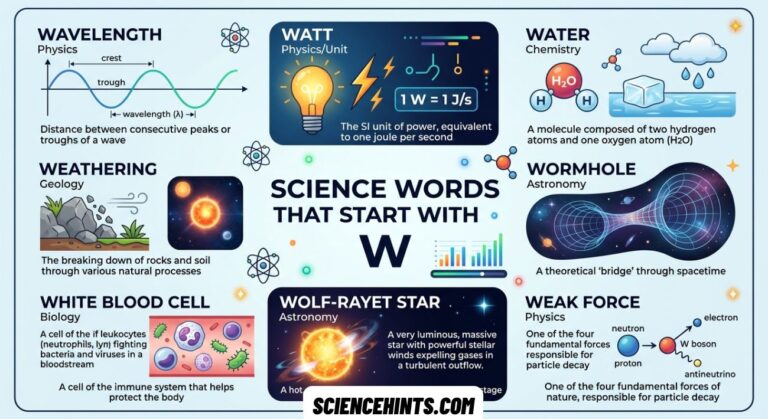
See Also : 300+ Science Words That Start With W
Astronomy & Space Science With S
Astronomy studies celestial objects and the universe beyond Earth. These astronomy words starting with S help you explore space terminology.
- Star – A luminous sphere of plasma held together by gravity.
- Sun – The star at the center of our solar system.
- Solar system – The gravitationally bound system of the Sun and orbiting objects.
- Satellite – An object that orbits a planet, either natural or artificial.
- Spacecraft – A vehicle designed for travel or operation in outer space.
- Space station – A large artificial satellite designed for humans to live and work in orbit.
- Supernova – The explosive death of a massive star.
- Singularity – A point in space-time where density and gravity become infinite.
- Solar flare – A sudden bright burst of energy from the Sun’s surface.
- Solar wind – A stream of charged particles released from the Sun’s corona.
- Spiral galaxy – A galaxy with a flat rotating disk containing spiral arms.
- Star cluster – A group of stars bound together by gravity.
- Sunspot – A temporary dark region on the Sun’s surface caused by magnetic activity.
- Shooting star – A meteor burning up as it enters Earth’s atmosphere.
- Spectral class – A classification system for stars based on their temperature and spectrum.
- Solstice – The time when the Sun reaches its highest or lowest point in the sky.
- Stratosphere – The second major layer of Earth’s atmosphere above the troposphere.
- Seyfert galaxy – A type of spiral galaxy with an active and bright nucleus.
- SETI – The Search for Extraterrestrial Intelligence.
- Superstring theory – A theoretical framework attempting to unify quantum mechanics and general relativity.
Earth & Environmental Science Words Starting With S
Earth science studies our planet’s structure, processes, and resources. These earth science vocabulary words and environmental science terms are crucial for understanding nature.
- Sediment – Small particles of rock, soil, and organic matter transported by water, wind, or ice.
- Sedimentation – The process of settling and accumulating sediment in a new location.
- Sedimentary rock – Rock formed from compressed and cemented sediment layers.
- Seismic – Relating to earthquakes or earth vibrations.
- Seismology – The scientific study of earthquakes and seismic waves.
- Soil – The upper layer of earth where plants grow, composed of minerals and organic matter.
- Strata – Layers of rock or soil with internally consistent characteristics.
- Stratigraphy – The study of rock layers and layering.
- Salinity – The salt concentration dissolved in water.
- Sinkhole – A depression in the ground caused by the collapse of a surface layer.
- Streamflow – The flow of water in streams, rivers, and channels.
- Surface water – Water located on top of the Earth’s surface in rivers, lakes, and oceans.
- Subduction – The process where one tectonic plate moves under another.
- Savanna – A grassland ecosystem with scattered trees and seasonal rainfall.
- Swamp – A forested wetland with standing water and woody vegetation.
- Snowpack – Accumulated snow that persists throughout the winter season.
- Storm surge – An abnormal rise in sea level during a storm.
- Silt – Fine sand or clay carried by moving water.
- Sustainability – Meeting present needs without compromising future generations’ resources.
- Stewardship – Responsible management and care of environmental resources.
Medical & Health Science Words That Start With S
Medical science focuses on human health, diseases, and treatments. These medical science words are used daily by healthcare professionals across the USA.
- Symptom – A subjective indication of a disease or condition experienced by a patient.
- Syndrome – A group of symptoms that consistently occur together.
- Surgery – Medical treatment involving an incision to repair or remove body tissue.
- Sterile – Completely free from bacteria and other living microorganisms.
- Sepsis – A life-threatening body response to infection causing organ dysfunction.
- Screening – Testing for disease in people without symptoms.
- Serum – The clear liquid that separates from blood when it clots.
- Sedative – A drug that calms or induces sleep.
- Supplement – A product taken to add nutritional value to the diet.
- Suture – A stitch used to close a wound or surgical incision.
- Spasm – A sudden involuntary muscle contraction.
- Sprain – An injury to a ligament caused by stretching or tearing.
- Scoliosis – An abnormal sideways curvature of the spine.
- Stroke – A medical emergency where blood flow to the brain is interrupted.
- Sanitation – Public health conditions related to clean drinking water and sewage disposal.
- Sphygmomanometer – An instrument for measuring blood pressure.
- Stethoscope – A medical device for listening to internal body sounds.
- Systolic pressure – The blood pressure when the heart beats and pumps blood.
- Synaptic plasticity – The ability of synapses to strengthen or weaken over time.
- Signal transduction – The process of transmitting molecular signals from a cell’s exterior to its interior.
Technology & Applied Science Words With S
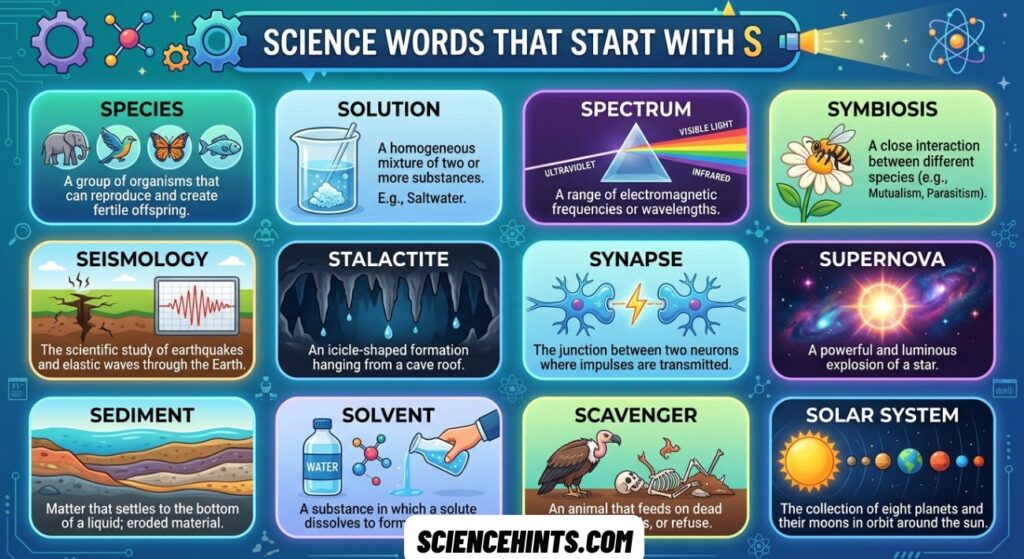
Technology applies science concepts to solve real-world problems. These technology science terms shape modern digital life and engineering.
- Software – Programs and operating information used by a computer.
- Sensor – A device that detects and responds to physical input from the environment.
- Server – A computer program or device that provides services to other programs or devices.
- Signal – An electrical or electromagnetic current that conveys data.
- Simulation – A virtual imitation of a real-world process or system.
- System – A set of connected parts forming a complex whole.
- Security – Protection of digital data from unauthorized access.
- Storage – A device or medium for recording and retaining digital data.
- Streaming – The continuous transmission of audio or video files.
- Synchronization – The coordination of events to operate in unison.
- Smartphone – A mobile phone with advanced computing and connectivity features.
- Scanner – A device that captures images from physical documents for digital processing.
- Satellite imaging – Capturing images of Earth from orbiting satellites.
- Sustainable technology – Innovations designed to reduce environmental impact.
- Supercomputer – An extremely powerful computer for performing complex calculations.
- Software engineering – The systematic application of engineering to software development.
- Semiconductor – A material with electrical conductivity between a conductor and insulator.
- Spectrophotometry – The measurement of light intensity as a function of wavelength.
- Sonar – Sound Navigation and Ranging used for underwater detection.
- Servo – An automatic device that uses feedback to correct mechanical performance.
Easy Science Words That Start With S
These science examples are perfect for beginners, kids, and elementary students learning science for students.
- Sun – The bright star that gives Earth light and heat.
- Snow – Frozen water vapor that falls as white flakes.
- Sand – Tiny loose pieces of rock found on beaches and deserts.
- Seed – The small part of a plant that grows into a new plant.
- Shell – The hard protective outer covering of some animals.
- Sky – The space above the Earth where clouds and stars appear.
- Smell – One of the five senses used to detect scents.
- Solid – A state of matter that holds a fixed shape.
- Space – The vast empty area beyond Earth’s atmosphere.
- Spring – The season between winter and summer.
- Stem – The main supporting part of a plant.
- Storm – A violent disturbance of the atmosphere with strong winds.
- Stream – A small flowing body of fresh water.
- Sugar – A sweet crystalline substance used as food.
- Swim – To move through water using limbs or fins.
- Sick – Affected by illness or disease.
- Sleep – A natural state of rest for the body and mind.
- Spider – An eight-legged arachnid that spins webs.
- Starfish – A star-shaped marine animal.
- Shadow – A dark area formed when light is blocked.
Advanced & Technical Science Words With S
These science terminology entries are designed for college students, researchers, and advanced science education.
- Superstring theory – A theoretical physics framework that models particles as vibrating strings.
- Superfluidity – A quantum state of matter with zero viscosity.
- Spintronics – Electronics technology exploiting electron spin.
- Synchrotron – A circular particle accelerator producing intense radiation beams.
- Stochastic – Processes involving randomly determined outcomes.
- Stereochemistry – The branch of chemistry focused on spatial atom arrangements.
- Signal transduction – Cellular mechanisms converting external signals into internal responses.
- Synaptic plasticity – The biological process of synapses strengthening or weakening.
- Spectrophotometry – Quantitative measurement of light reflection and transmission properties.
- Schrödinger equation – The fundamental equation of non-relativistic quantum mechanics.
- Speciation – The evolutionary formation of new distinct species.
- Siderophile elements – Transition metals with an affinity for iron that sink toward planetary cores.
- Schlieren photography – A technique for visualizing fluid flow density changes.
- Saponification – The chemical reaction converting fat into soap and glycerol.
- Stereoisomerism – A form of isomerism with identical formulas but different 3D orientations.
- Subduction zone – A region where one tectonic plate sinks beneath another.
- Stratigraphy – The geological study of rock layers and stratification.
- Seyfert galaxy – A spiral galaxy with an unusually bright active nucleus.
- Systems biology – The computational modeling of complex biological systems.
- Supersaturated solution – A metastable solution containing more dissolved solute than equilibrium allows.
See Also : 330+ Science Words That Start With F
Scientific Theories & Laws Starting With S
Foundational science concepts are built on tested theories and laws. These scientific terms beginning with S describe the frameworks that explain how the universe works.
- Second Law of Thermodynamics – The principle stating that the total entropy of an isolated system always increases over time.
- Special Relativity – Einstein’s theory explaining how space and time are linked for objects moving at constant speeds.
- Standard Model – The theoretical framework describing all known elementary particles and three fundamental forces.
- String Theory – A theoretical model proposing that fundamental particles are tiny vibrating strings of energy.
- Superposition Principle – The quantum rule stating a system exists in all possible states until measured or observed.
- Stefan-Boltzmann Law – The principle that the total energy radiated by a black body is proportional to its temperature raised to the fourth power.
- Snell’s Law – A formula describing how light bends when passing from one transparent medium into another.
- Schrödinger Equation – The fundamental equation of quantum mechanics describing how quantum states evolve over time.
- Selection Theory – Darwin’s explanation of how organisms with advantageous traits survive and reproduce more successfully.
- Signal Detection Theory – A framework for measuring how decisions are made under conditions of uncertainty.
- Social Learning Theory – The concept that people learn behaviors by observing and imitating others in social contexts.
- Spontaneous Generation – The disproven historical belief that living organisms could arise from nonliving matter.
- Steady State Theory – A now-rejected cosmological model proposing the universe has always existed without a beginning.
- Symbiogenesis – The theory that complex cells evolved through the merging of simpler prokaryotic organisms.
- Supersymmetry – A theoretical extension of the Standard Model predicting every particle has a heavier partner particle.
- Self-Determination Theory – A psychological framework explaining human motivation through autonomy, competence, and relatedness needs.
- Social Exchange Theory – A sociological model suggesting relationships are maintained based on perceived costs and rewards.
- Strain Theory – A sociological explanation linking societal pressures to deviant behavior and crime.
- Signal Theory – An evolutionary concept explaining how organisms communicate honest information through costly displays.
- Systems Theory – An interdisciplinary framework studying complex, interconnected systems in nature and society.
Space Exploration & Missions Words With S
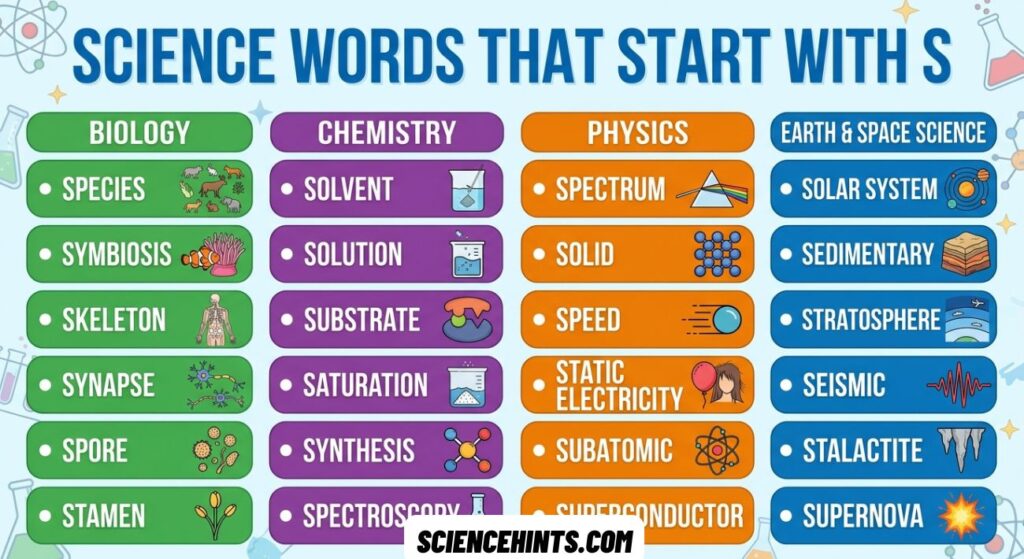
Humanity’s journey into the cosmos is described by these science vocabulary words. These astronomy terms capture the spirit of scientific research beyond Earth.
- Spacecraft – A vehicle or machine designed to fly and operate in the vacuum of outer space.
- Satellite – An artificial object intentionally placed into orbit around Earth or another celestial body.
- Space Shuttle – A partially reusable low Earth orbital spacecraft system operated by NASA from 1981 to 2011.
- Space Station – A large habitable artificial structure designed to remain in space for extended periods supporting human crew.
- Skylab – The first United States space station, launched and operated by NASA in the 1970s.
- Soyuz – A series of Russian spacecraft designed for transporting cosmonauts to and from orbit.
- Spacesuit – A pressurized garment worn by astronauts providing life support and protection in the vacuum of space.
- Service Module – The section of a spacecraft containing propulsion, power, and life support systems.
- Solar Panel – A flat assembly of photovoltaic cells converting sunlight into electrical power for spacecraft.
- Soft Landing – A controlled spacecraft touchdown that prevents damage to the vehicle and its contents.
- Stage Separation – The process of discarding used rocket sections during ascent to reduce weight.
- Suborbital Flight – A spaceflight that reaches space but does not complete an orbital revolution around Earth.
- Saturn V – The powerful multistage rocket developed by NASA that sent Apollo missions to the Moon.
- Sputnik – The first artificial Earth satellite, launched by the Soviet Union in 1957.
- Spacewalk – An extravehicular activity where an astronaut leaves the spacecraft to work in open space.
- Solar Sail – A propulsion method using the pressure of sunlight on large reflective surfaces for movement.
- Sample Return Mission – A spaceflight designed to collect samples from another world and bring them back to Earth.
- Space Debris – Non-functional, human-made objects in orbit around Earth posing collision risks to active spacecraft.
- Starliner – Boeing’s crew spacecraft designed to transport astronauts to the International Space Station.
- Starship – SpaceX’s fully reusable super heavy-lift launch vehicle designed for deep space exploration.
States of Matter & Phase Changes Starting With S
Understanding matter requires mastering these chemistry terms and physics terms. These science definitions explain how substances exist and transform.
- Solid – The state of matter characterized by a fixed shape and volume with particles packed tightly together.
- Sublimation – The direct phase transition from solid to gas without passing through the liquid state.
- Saturated Vapor – A gaseous state where vapor is in equilibrium with its liquid or solid phase at a given temperature.
- Supercooled Liquid – A liquid cooled below its normal freezing point without turning into a solid.
- Superheated Liquid – A liquid heated above its boiling point without actually boiling due to lack of nucleation sites.
- Supersaturated Solution – An unstable solution containing more dissolved solute than equilibrium conditions normally allow.
- Superfluid – A bizarre state of matter with zero viscosity that flows without losing kinetic energy.
- Supersolid – A theoretical quantum state where matter maintains a rigid structure yet flows with zero friction.
- Supercritical Fluid – A substance above its critical point where distinct liquid and gas phases do not exist.
- Surface Tension – The elastic-like force existing at the surface of a liquid caused by cohesive molecular forces.
- Surfactant – A compound that lowers surface tension between two liquids or between a liquid and a solid.
- Sol – A colloidal suspension of very small solid particles dispersed in a continuous liquid medium.
- Smoke – A suspension of fine solid particles and liquid droplets dispersed in a gas, typically from combustion.
- Steam – The invisible gaseous phase of water formed when water boils or evaporates.
- Slurry – A semi-liquid mixture of fine solid particles suspended in a liquid, typically water.
- Scum – A layer of impurities or insoluble material that forms on the surface of a liquid.
- Scale – A hard mineral coating that precipitates and deposits on surfaces from hard water.
- Sedimentation – The natural process where suspended particles settle to the bottom of a liquid over time.
- Sintering – The process of compacting and forming a solid mass by heat or pressure without melting completely.
- Solidification – The phase change where a liquid turns into a solid as temperature drops below its freezing point.
Scientific Safety & Laboratory Words With S
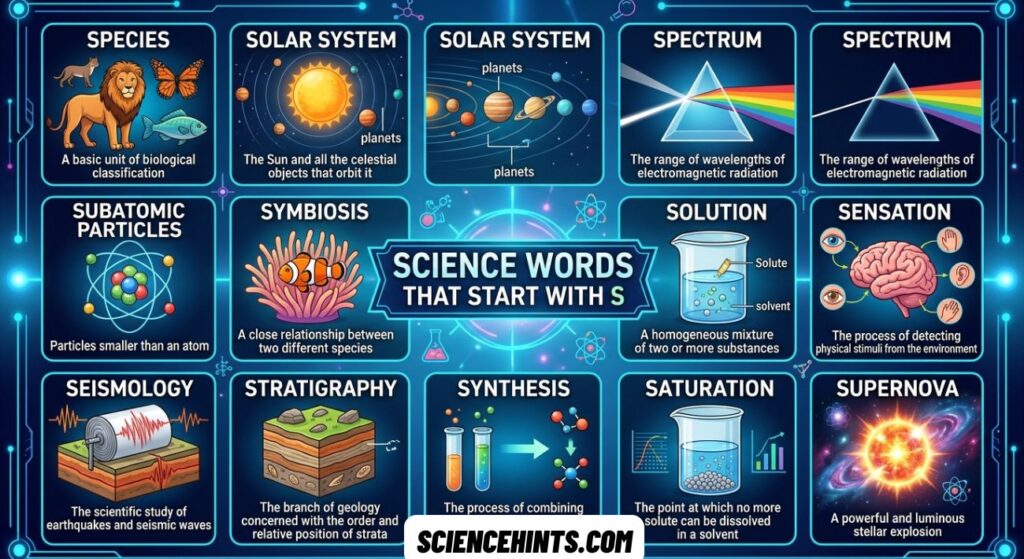
Safety is the cornerstone of all laboratory vocabulary. These science terms that start with S protect researchers and ensure reliable scientific research.
- Safety goggles – Protective eyewear worn in laboratories to shield eyes from chemical splashes and flying debris.
- Safety shower – An emergency fixture that drenches a person with water to wash off hazardous chemical spills.
- Spill kit – A collection of absorbent materials and tools designed to clean up chemical or biological spills safely.
- Sterile technique – A set of procedures used to prevent contamination by unwanted microorganisms during experiments.
- Sanitization – The process of reducing microbial populations on surfaces to levels considered safe by public health standards.
- Sterilization – The complete elimination of all microorganisms including bacterial spores from equipment or media.
- Sharps container – A puncture-resistant container used for safe disposal of needles, scalpels, and broken glass.
- Safety Data Sheet – A detailed document providing information about the hazards and handling of a chemical substance.
- Standard Operating Procedure – A written set of step-by-step instructions for performing laboratory tasks safely and consistently.
- Secondary containment – A backup container placed under primary chemical storage to catch leaks or spills.
- Sash – The movable transparent panel on a fume hood that protects the user while allowing access inside.
- Scrubber – A device that removes pollutants or hazardous gases from laboratory exhaust before release.
- Spill tray – A shallow container placed under equipment to contain accidental drips or overflow of liquids.
- Signage – Posted symbols and warnings indicating specific hazards present in different areas of the laboratory.
- Segregation – The practice of storing incompatible chemicals separately to prevent dangerous reactions.
- Sample labeling – The critical process of clearly marking specimen containers with contents, date, and hazard information.
- Smoke detector – A sensor device that alerts occupants to the presence of smoke indicating a potential fire.
- Sprinkler system – An automatic fire suppression network that releases water when high temperatures are detected.
- Safety audit – A systematic inspection of laboratory practices and equipment to identify and correct potential hazards.
- Sentinel event – A significant unexpected occurrence in a laboratory or clinical setting requiring immediate investigation.
Scientific Symbols & Notation Starting With S
Symbols are the universal shorthand of scientific language. These science vocabulary words represent the notations used in scientific research and communication.
- S – The chemical symbol for sulfur, element number 16 on the periodic table with a bright yellow color.
- Si – The chemical symbol for silicon, the metalloid element essential for semiconductor manufacturing.
- Na – The chemical symbol for sodium, derived from the Latin word natrium for this reactive alkali metal.
- Σ (Sigma) – The Greek uppercase letter used in mathematics to represent the sum of a series of terms.
- σ (sigma) – The Greek lowercase letter representing standard deviation, electrical conductivity, and surface tension.
- s (second) – The standard abbreviation for second, the base SI unit of time measurement.
- S (siemens) – The symbol for siemens, the SI unit of electrical conductance named after Ernst Werner von Siemens.
- Sv (sievert) – The symbol for sievert, measuring the health effect of ionizing radiation on human tissue.
- Svedberg (S) – The unit symbol for sedimentation rate in ultracentrifugation, named after Theodor Svedberg.
- s-orbital – The spherical atomic orbital shape where electrons are most likely found closest to the nucleus.
- sp Hybridization – A linear arrangement of atomic orbitals forming two equivalent hybrid orbitals 180 degrees apart.
- Sp² Hybridization – A trigonal planar orbital arrangement forming three hybrid orbitals with 120-degree bond angles.
- Sp³ Hybridization – A tetrahedral orbital arrangement forming four equivalent hybrid orbitals at 109.5-degree angles.
- S₀ (Standard Entropy) – The symbol representing the absolute entropy of a substance under standard conditions.
- Sₙ – The notation for a symmetric group in mathematics describing all permutations of n elements.
- SiO₂ – The chemical formula for silicon dioxide, commonly known as silica or quartz.
- SO₂ – The chemical formula for sulfur dioxide, a pungent gas produced by volcanic activity and fossil fuel combustion.
- S/N Ratio – The signal-to-noise ratio notation comparing the level of desired signal to background interference.
- Sₙ1 Reaction – The symbol for a unimolecular nucleophilic substitution mechanism in organic chemistry.
- Sₙ2 Reaction – The symbol for a bimolecular nucleophilic substitution reaction occurring in a single step.
See Also : 300+ Science Words That Start With R
Fun Facts About Science Words That Start With S
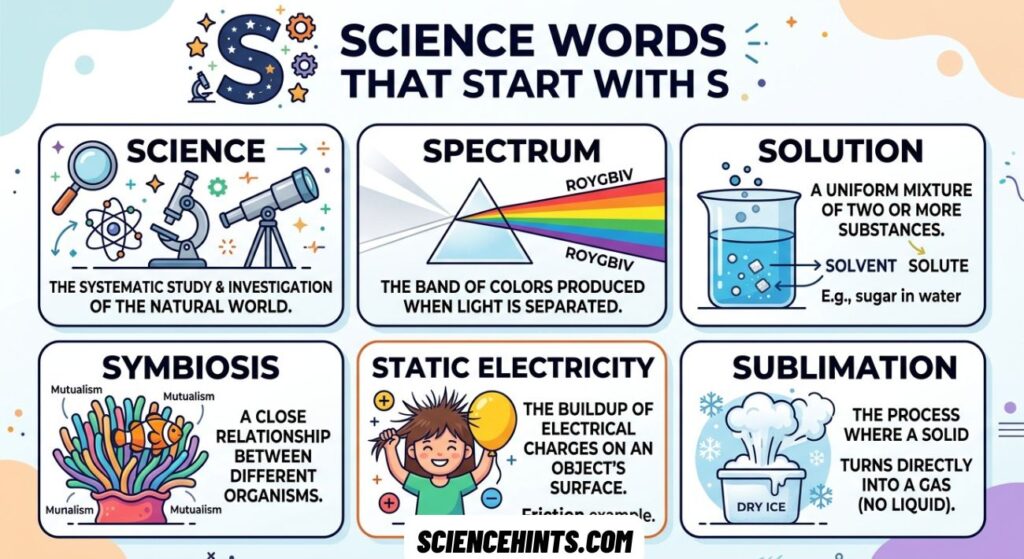
Here are interesting facts about science definitions and scientific knowledge connected to the letter S.
- Science itself starts with S – The word science comes from the Latin word “scientia” meaning knowledge.
- Sun accounts for 99.86% of the solar system’s mass – Our star dominates the entire planetary system.
- Sound travels four times faster in water than in air – This is due to the closer molecular spacing in liquids.
- Stem cells can develop into over 200 different cell types – They are the body’s master builders.
- Static electricity can reach 25,000 volts – A typical household socket is only 120 volts in the USA.
- Supernovae create the heavy elements in our bodies – The calcium in your bones was forged in stellar explosions.
- Spiders are not insects – They are arachnids with eight legs and belong to class Arachnida.
- Semiconductors made the digital age possible – Silicon Valley is named after the primary semiconductor material.
- Soil contains billions of microorganisms per teaspoon – Healthy soil is incredibly alive.
- Synapses in the human brain number over 100 trillion – This creates the most complex network known.
Comparison Table: Physical Science vs. Life Science Words Starting With S
| Feature | Physical Science S-Words | Life Science S-Words |
|---|---|---|
| Focus | Matter, energy, and non-living systems | Living organisms and biological processes |
| Example 1 | Scalar – Quantity with magnitude only | Species – Group of interbreeding organisms |
| Example 2 | Spectrum – Range of light wavelengths | Symbiosis – Species interaction |
| Example 3 | Sublimation – Solid to gas transition | Stomata – Plant leaf pores |
| Example 4 | Superconductor – Zero-resistance material | Synapse – Neural junction |
| Example 5 | Surface tension – Liquid cohesion force | Stem cell – Undifferentiated cell |
| Application | Engineering, electronics, astronomy | Medicine, ecology, genetics |
Frequently Asked Questions
What are the S words in science?
S words in science include species, solution, spectrum, synthesis, sediment, symbiosis, and solar system. They are common scientific terms used in many fields of science.
What are 10 words that start with S?
Ten science words that start with S are species, solution, spectrum, synthesis, sediment, solvent, satellite, stimulus, sulfur, and symbiosis.
What are 50 science words?
Fifty science words include atom, cell, energy, force, gravity, molecule, species, solution, spectrum, synthesis, and many other terms from biology, chemistry, physics, and Earth science.
What’s a fancy word for science?
A fancy word for science is scientific knowledge or scientific study. Other related words include research, inquiry, and natural science.
Conclusion
Science Words That Start With S help students learn many important science ideas in a simple way. These words are used in biology, chemistry, physics, space science, and many other subjects. Some words are easy, like sun and soil, while others are more advanced, like spectrum and stoichiometry. Learning these words builds a strong science vocabulary. It also helps students read, write, and understand science with more confidence.
Science Words That Start With S make science lessons more interesting and useful. Every new word gives a better understanding of the world and how things work. Students can use these words in schoolwork, projects, and daily learning. A strong science vocabulary supports better communication and improves knowledge. Learning a few new science words every day helps students grow and enjoy science with confidence.