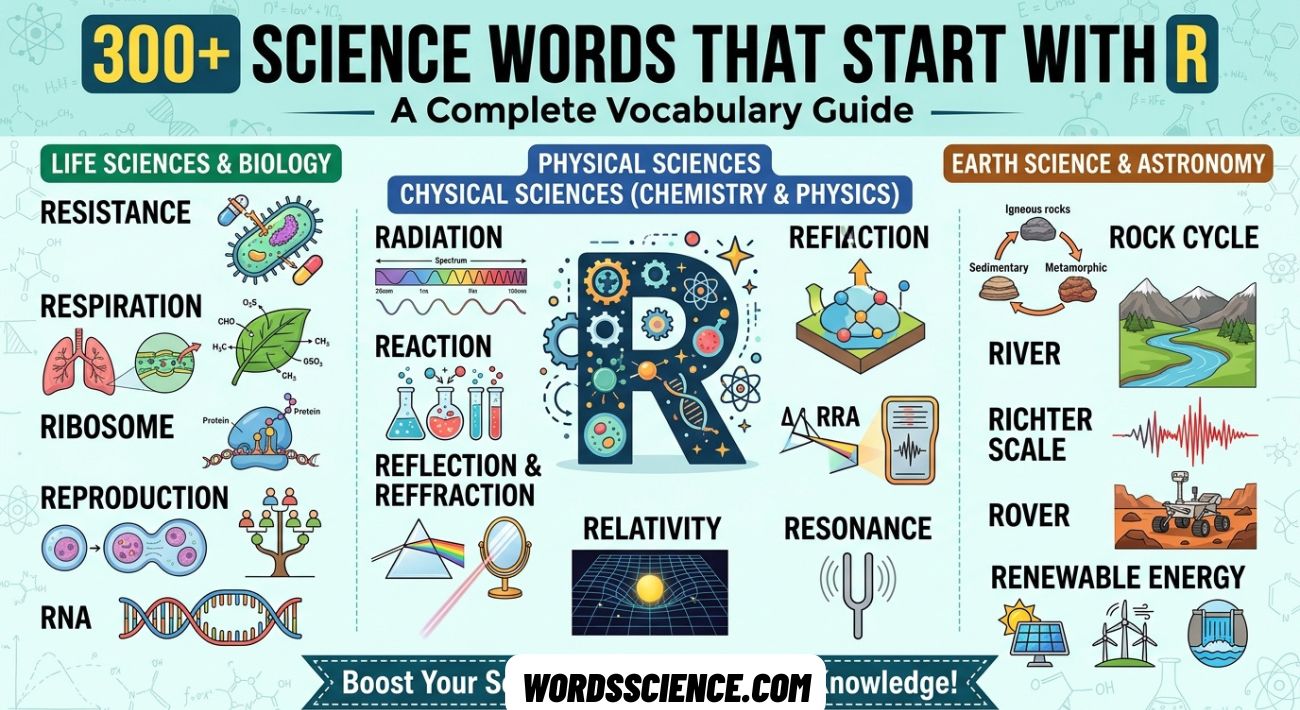
300+ Science Words That Start With R: A Complete Vocabulary Guide
Science Words That Start With R are scientific terms that begin with the letter R. These words explain ideas, objects, and processes in science. They help students learn and use scientific vocabulary with confidence.
Many important science words start with R. You may already know words like reaction, radiation, and respiration. Learning these words makes science easier to understand and more interesting.
Science Words That Start With R are used in biology, chemistry, physics, Earth science, and medicine. They appear in school lessons, books, and experiments. Building this vocabulary helps improve science knowledge and communication.
Why Science Words That Start With R Matter
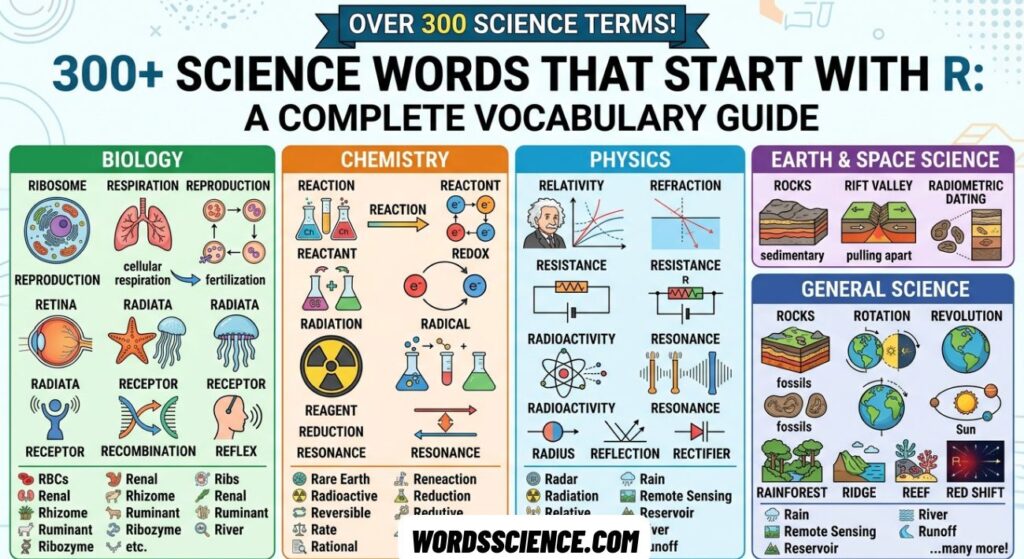
Building a strong science vocabulary list helps students understand textbooks, lectures, and lab instructions more easily. When learners master scientific terminology by letter groups like this, they create mental filing systems that make recall faster during exams and real-world applications.
Science words for students serve as building blocks for STEM vocabulary across all grade levels. Teachers use these science classroom vocabulary lists to design lessons and assessments. ESL learners benefit from the simple format that connects science word meanings to clear examples without complicated jargon.
Writers and researchers rely on precise scientific language to communicate discoveries accurately. A solid grasp of scientific concepts and scientific principles supports lifelong science learning and helps everyone make informed decisions about health, technology, and the environment.
Physics Science Words That Start With R
Physics explains matter, energy, motion, and forces. These physics words starting with R cover mechanics, electromagnetism, thermodynamics, and modern physics.
- Radiation – Energy that travels through space as waves or particles.
- Radioactivity – The spontaneous emission of particles or energy from an unstable atomic nucleus.
- Radiant energy – Energy transmitted in the form of electromagnetic waves.
- Refraction – The bending of light as it passes from one medium into another.
- Reflection – The bouncing back of light or sound waves from a surface.
- Relativity – Einstein’s theory describing the relationship between space, time, and gravity.
- Resistance – The opposition to the flow of electric current measured in ohms.
- Resonance – The increased amplitude that occurs when a system vibrates at its natural frequency.
- Resultant force – The single force that represents the combined effect of all forces acting on an object.
- Reaction force – The equal and opposite force exerted back when one object pushes on another.
- Recoil – The backward movement of an object after it ejects or releases something forward.
- Rotation – The spinning motion of an object around its own axis.
- Revolution – The movement of one object in an orbit around another object.
- Radius – The distance from the center of a circle or sphere to its outer edge.
- Radian – A unit of angular measurement used in mathematics and physics.
- Random motion – The unpredictable movement of particles in a gas or liquid.
- Ray – A straight line along which light or other radiation travels.
- Radiometer – A device that detects and measures electromagnetic radiation.
- Rest mass – The mass of an object when it is not moving relative to an observer.
- Reaction – A process in which substances interact to form new substances with different properties.
Chemistry Science Words That Start With R
Chemistry studies matter and how substances interact, combine, and change. These chemistry words starting with R include essential lab terminology and core concepts.
- Reaction – A process where chemical substances change into different substances.
- Reactant – A starting substance that undergoes change in a chemical reaction.
- Reagent – A substance added to cause or test for a chemical reaction.
- Reactivity – The tendency of a substance to undergo chemical reactions.
- Redox – A chemical reaction where oxidation and reduction occur together.
- Reduction – The gain of electrons by an atom or molecule during a reaction.
- Radioactive isotope – An unstable form of an element that emits radiation as it decays.
- Radioisotope – An atom with an unstable nucleus that releases energy to become stable.
- Radical – A highly reactive atom or molecule with an unpaired electron.
- Resonance structure – One of multiple valid Lewis structures that represent a single molecule.
- Rust – Iron oxide formed when iron reacts with oxygen and water.
- Reaction rate – The speed at which reactants turn into products.
- Reducing agent – A substance that donates electrons to another during a redox reaction.
- Reversible reaction – A reaction that can proceed in both forward and backward directions.
- Rare earth element – Any of seventeen metallic elements with similar chemical properties.
- Racemic mixture – A solution containing equal amounts of left- and right-handed enantiomers.
- Radium – A radioactive alkaline earth metal element with symbol Ra.
- Radon – A radioactive noble gas formed from the decay of radium.
- Raney nickel – A solid catalyst made from nickel-aluminum alloy used in hydrogenation.
- Retention time – The time a compound takes to pass through a chromatography column.
Biology Science Words That Start With R
Biology explores living organisms and life processes. These biology words starting with R cover cells, genetics, anatomy, and ecosystems.
- Respiration – The process by which cells release energy from food molecules.
- Ribosome – A tiny cell structure where proteins are made.
- RNA – Ribonucleic acid that carries genetic instructions from DNA for protein synthesis.
- Replication – The process of copying DNA before cell division.
- Reproduction – The biological process by which organisms produce offspring.
- Receptor – A protein or cell structure that detects signals from the environment.
- Reflex – An automatic and rapid response to a stimulus without conscious thought.
- Regeneration – The ability of an organism to regrow lost or damaged body parts.
- Recombinant DNA – DNA molecules formed by combining genetic material from different sources.
- Red blood cells – Cells in the blood that carry oxygen throughout the body.
- Recessive trait – A genetic characteristic expressed only when two copies of the allele are present.
- Renal system – The organ system that filters blood and produces urine including the kidneys.
- Reproductive system – The organs and structures involved in producing offspring.
- Rhizome – An underground plant stem that grows horizontally and produces new shoots.
- Rumen – The first stomach compartment in cows and other ruminants where microbes digest fiber.
- Root – The underground part of a plant that absorbs water and anchors it in place.
- Regulatory gene – A gene that controls the expression of other genes.
- Restriction enzyme – A protein that cuts DNA at specific sequences used in genetic engineering.
- Retina – The light-sensitive layer at the back of the eye that contains photoreceptor cells.
- Rhodopsin – A light-sensitive pigment found in rod cells of the retina.
Astronomy & Space Science Words That Start With R
Astronomy examines celestial objects, space, and the universe. These astronomy words starting with R include stellar phenomena and space exploration terms.
- Red giant – A large cool star in a late stage of stellar evolution with a reddish appearance.
- Red dwarf – A small relatively cool star that is the most common type in the Milky Way.
- Redshift – The stretching of light toward longer wavelengths as objects move away in space.
- Radiation belt – A zone of charged particles trapped by a planet’s magnetic field.
- Rocket – A vehicle that uses thrust from expelled gases to travel through space.
- Rocket propulsion – The force that moves a rocket forward by ejecting exhaust backward.
- Radio telescope – An instrument that detects radio waves from celestial objects.
- Reflection nebula – A cloud of dust that shines by reflecting light from nearby stars.
- Roche limit – The minimum distance a satellite can approach a planet without being torn apart.
- Retrograde motion – The apparent backward movement of a planet across the sky.
- Ring system – A collection of particles orbiting a planet in a flat disk shape.
- Radiant point – The location in the sky from which meteors in a shower appear to originate.
- Regolith – The layer of loose rock and dust covering solid bedrock on a planet or moon.
- Right ascension – A coordinate used in astronomy similar to longitude on Earth.
- Revolution – The orbital motion of one celestial body around another.
- Rotation – The spinning of a celestial body on its axis.
- Roche lobe – The region around a star in a binary system where material is gravitationally bound.
- Runaway star – A star moving through space at an unusually high velocity.
- R process – Rapid neutron capture process that creates heavy elements in supernovae.
- Radiative zone – The region inside a star where energy moves outward through radiation.
Earth & Environmental Science Words That Start With R
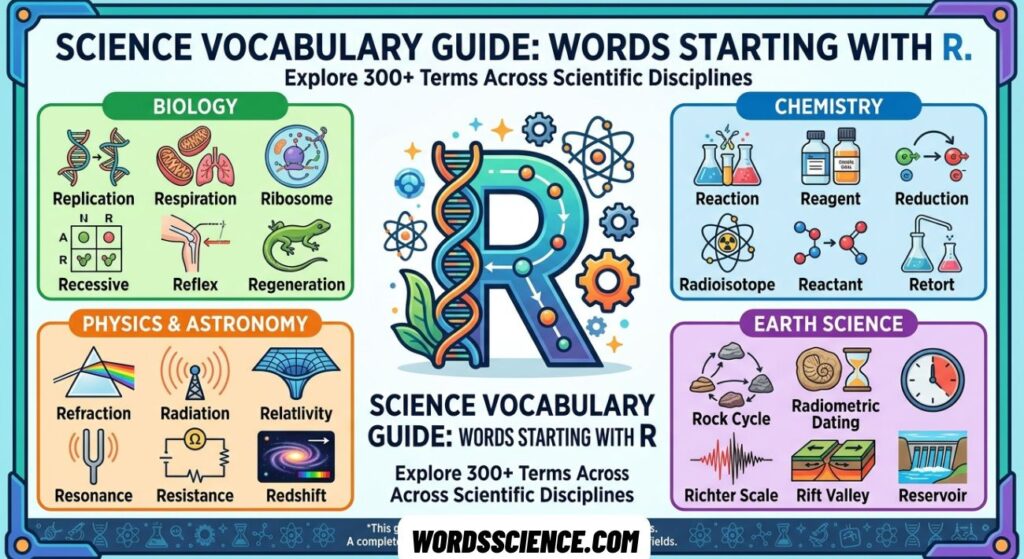
Earth science studies our planet’s systems and processes. These earth science words starting with R and environmental science words cover geology, weather, and ecology.
- Rainfall – Water droplets that fall from clouds to the Earth’s surface.
- Recycling – The process of converting waste materials into new reusable products.
- Renewable energy – Energy from sources that naturally replenish like sunlight, wind, and water.
- Renewable resources – Natural resources that can be replaced over relatively short time periods.
- Runoff – Water that flows over the land surface into streams, rivers, and oceans.
- Rock cycle – The continuous process by which rocks change from one type to another.
- Reservoir – A natural or artificial lake used to store water for human use.
- River basin – The entire area of land drained by a river and its tributaries.
- Ridge – A long narrow elevated landform or underwater mountain chain.
- Rainforest – A dense forest with high rainfall found in tropical regions.
- Reforestation – The planting of trees in an area where forest was previously removed.
- Resilience – The ability of an ecosystem to recover after a disturbance or damage.
- Radiative forcing – The change in energy balance of Earth’s atmosphere due to factors like greenhouse gases.
- Remote sensing – Gathering information about Earth’s surface using satellites or aircraft.
- Rift valley – A lowland region formed where tectonic plates move apart.
- Resource management – The practice of using natural resources wisely and sustainably.
- Regolith – The layer of loose soil and rock fragments covering Earth’s bedrock.
- Riparian zone – The interface between land and a river or stream with unique vegetation.
- Radiocarbon dating – A method to determine the age of organic materials using carbon-14 decay.
- Relative humidity – The amount of water vapor in air compared to the maximum it can hold.
Medical & Health Science Words That Start With R
Medical science focuses on human health, disease, and treatment. These medical science words help understand body systems and healthcare practices.
- Radiology – The medical specialty using imaging to diagnose and treat diseases.
- Radiotherapy – The use of high-energy radiation to kill cancer cells and shrink tumors.
- Remission – The reduction or disappearance of signs and symptoms of a disease.
- Retrovirus – A virus that inserts its RNA genetic material into the DNA of a host cell.
- Renal – Relating to or affecting the kidneys.
- Resection – The surgical removal of part of a tissue or organ.
- Reflex – An involuntary response of the body to a stimulus controlled by the nervous system.
- Rehabilitation – The process of restoring a person to health or normal life through therapy.
- Resuscitation – The act of reviving someone from unconsciousness or apparent death.
- Rheumatology – The medical field dealing with joints, soft tissues, and autoimmune conditions.
- Rhinitis – Inflammation of the mucous membrane inside the nose.
- Rickets – A bone disease in children caused by vitamin D deficiency.
- Rubella – A contagious viral infection also known as German measles.
- Rabies – A deadly viral disease transmitted through animal bites affecting the nervous system.
- Receptor – A protein molecule that receives chemical signals from outside a cell.
- Red blood cells – Cells containing hemoglobin that transport oxygen throughout the body.
- Respiratory system – The organs involved in breathing including lungs, trachea, and diaphragm.
- Reproductive system – The biological system made up of organs involved in sexual reproduction.
- Recombinant DNA – DNA altered by combining sequences from different organisms for medical use.
- Radical mastectomy – A surgical procedure that removes the breast and surrounding tissues.
Technology & Applied Science Words That Start With R
Technology applies scientific knowledge for practical purposes. These technology science words explain computing, engineering, and digital systems.
- Robotics – The field of designing, building, and operating robots for various tasks.
- Radar – A system using radio waves to detect objects and measure their distance and speed.
- RAM – Random Access Memory that temporarily stores data for quick computer processing.
- Router – A networking device that forwards data packets between computer networks.
- RFID – Radio Frequency Identification that uses electromagnetic fields to track tags on objects.
- Rendering – The process of generating an image from a digital model using computer software.
- Runtime – The period during which a computer program is executing or running.
- Resolution – The number of pixels displayed on a screen determining image sharpness and detail.
- Remote access – The ability to connect to and control a computer from a distant location.
- Routing algorithm – The method used to determine the best path for data across a network.
- Robotic automation – Using robots to perform tasks that humans previously handled.
- Robotic vision – Technology enabling robots to see and interpret visual information from cameras.
- Rechargeable battery – A battery that can be charged and used multiple times through reversible chemical reactions.
- Reliability engineering – The field focused on ensuring products perform consistently without failure.
- Rapid prototyping – Quickly creating a physical model from a digital design using 3D printing.
- Responsive design – Web design approach making pages render well on all screen sizes and devices.
- Refractory material – A substance resistant to high temperatures used in furnaces and kilns.
- Reverse engineering – Taking apart an object to understand its design and how it works.
- Redundancy – Having backup components or systems to increase reliability if one fails.
- Real-time system – A computing system that responds to inputs within a strict time deadline.
Easy Science Words That Start With R
These easy science words and common science words are perfect for beginners, young students, and anyone starting their science learning journey.
- Rain – Water falling from clouds in drops.
- Root – The underground part of a plant.
- Rock – A solid natural material made of minerals.
- River – A large flowing body of water.
- Ray – A thin line or beam of light.
- Red – The color with the longest wavelength visible to the human eye.
- Round – Having a circular or curved shape.
- Ring – A circular band or object.
- Runny – Having a liquid consistency that flows easily.
- Rub – To move one surface against another creating friction.
- Rust – The reddish-brown coating formed on iron exposed to moisture.
- Ripe – Fully developed and ready to eat or harvest.
- Roar – A loud deep sound like that of a lion or an engine.
- Rest – A state of inactivity or not moving.
- Rot – To decay or decompose naturally.
- Rough – Having an uneven or bumpy surface texture.
- Raw – In a natural state without being processed or cooked.
- Race – A competition of speed.
- Rise – To move upward or increase in level.
- Rod – A thin straight bar or stick.
Advanced & Technical Science Words That Start With R
These advanced science terms appear in higher-level scientific communication, research papers, and specialized science study guide materials for college and professional use.
- Radiative transfer – The physical phenomenon of energy moving through a medium via radiation.
- Raman spectroscopy – A technique using scattered light to analyze molecular vibrations.
- Recombinase – An enzyme that catalyzes genetic recombination between DNA sequences.
- Reynolds number – A dimensionless quantity predicting fluid flow patterns.
- Rheology – The study of the flow of matter primarily in liquid and soft solid states.
- Ribozyme – An RNA molecule capable of acting as an enzyme.
- Rotational spectroscopy – The study of molecular rotation using microwave spectra.
- Radiolysis – The dissociation of molecules by ionizing radiation.
- Retrotransposon – A genetic element that can amplify itself using an RNA intermediate.
- Radiometric dating – Measuring radioactive decay to determine the age of materials.
- Reaction mechanism – The step-by-step sequence of elementary reactions by which a chemical change occurs.
- Recrystallization – A purification technique where a solid dissolves and reforms as purer crystals.
- Relativistic mechanics – Physics that accounts for effects predicted by Einstein’s theory of relativity.
- Resonance frequency – The natural frequency at which a system vibrates with maximum amplitude.
- Reticular formation – A network of neurons in the brainstem regulating alertness and sleep.
- Rhizosphere – The soil zone surrounding plant roots influenced by root secretions.
- Ribonucleoprotein – A complex of RNA and protein found in ribosomes and other cellular structures.
- Refractometry – The measurement of how much light bends when entering a substance.
- Radiotracer – A radioactive isotope used to track biological or chemical processes.
- Recombinant protein – A protein produced from genetically engineered DNA in a host organism.
Science Words That Start With R for Kids
These science words that start with r are chosen specifically for young learners building their first science vocabulary list. Each term connects to things children can see, touch, or experience in daily life.
- Rainbow – An arc of colors formed when sunlight shines through water droplets.
- Rabbit – A small mammal with long ears studied in biology for its reproductive habits.
- Raccoon – A nocturnal mammal known for its intelligence and dexterous front paws.
- Rattle – A sound made by some snakes and insects as a warning signal.
- Roost – A place where birds or bats rest or sleep.
- Roe – The mass of eggs found inside female fish and other water animals.
- Rump – The hind part of an animal’s body.
- Runner – A plant stem that grows along the ground and produces new roots.
- Rind – The tough outer skin of fruits like oranges and watermelons.
- Rose – A flowering plant often used in botanical studies of pollination.
- Robin – A common bird species studied in animal behavior and migration.
- Reef – A ridge of rock or coral near the surface of the ocean.
- Ripple – A small wave or series of waves on the surface of water.
- Roar – A loud vocal sound produced by big cats and other animals.
- Roly-poly – A small armored bug that rolls into a ball when threatened.
- Rustle – The soft sound made by leaves or paper moving.
- Reach – To stretch out or extend toward something.
- Rinse – To wash something with clean water to remove dirt or soap.
- Rubber – A flexible waterproof material made from tree sap or synthetics.
- Ruler – A tool used to measure length in science experiments.
Scientific Processes and Methods That Start With R
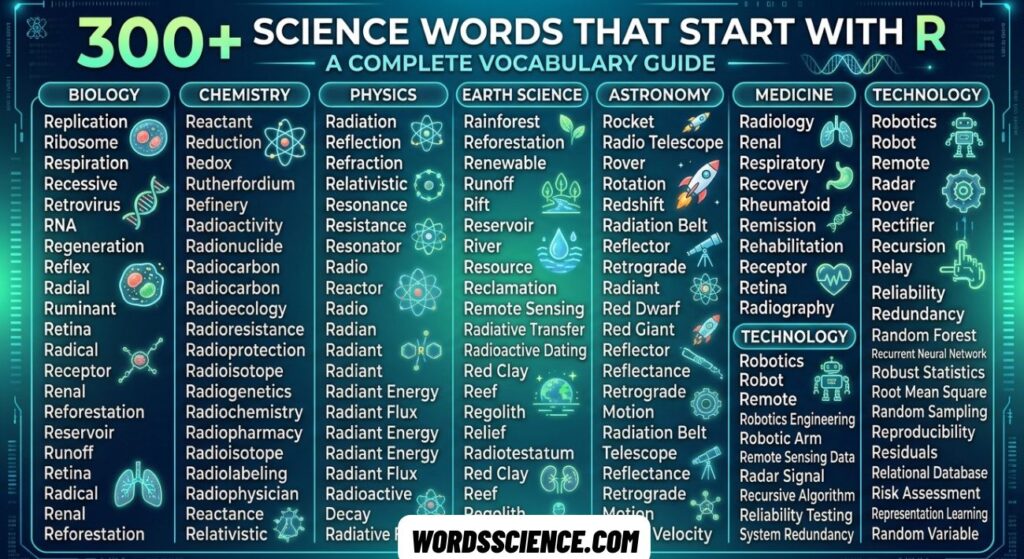
Every branch of scientific processes uses specific methods to explore, test, and understand natural phenomena. These terms describe how scientists conduct research and validate scientific principles.
- Research – The systematic investigation to establish facts and reach new conclusions.
- Reasoning – The logical thinking process used to draw conclusions from evidence.
- Replication – Repeating an experiment to verify results and confirm accuracy.
- Random sampling – Selecting subjects by chance so every individual has an equal opportunity.
- Reliability – The consistency and dependability of measurements or experimental results.
- Repeatability – The ability to obtain the same result when an experiment runs again under identical conditions.
- Reproducibility – Getting consistent results when different researchers perform the same experiment.
- Recording – Writing down observations, measurements, and data during an investigation.
- Review – Examining and evaluating scientific work before publication.
- Revision – Making changes to improve a hypothesis, method, or conclusion.
- Refinement – The process of making small improvements to a procedure or instrument.
- Re-evaluation – Looking at data again with fresh perspective or new information.
- Rational analysis – Breaking down a problem using logic and evidence.
- Reductionism – Understanding complex systems by studying their simpler components.
- Regression analysis – A statistical method to find relationships between variables.
- Randomized trial – An experiment where subjects are assigned to groups purely by chance.
- Risk assessment – Evaluating potential hazards and their likely impacts.
- Root cause analysis – Identifying the fundamental source of a problem or failure.
- Reference point – A fixed location used to measure the position or motion of objects.
- Range – The difference between the highest and lowest values in a data set.
Laboratory Tools and Equipment That Start With R
Science labs contain specialized instruments for conducting experiments. These science education terms describe common equipment found in school, college, and professional laboratories.
- Rack – A frame for holding test tubes and other small lab items upright.
- Retort – A glass container with a long bent neck used for distillation.
- Reagent bottle – A container designed to store chemical substances safely.
- Rubber tubing – Flexible hollow pipe used to connect laboratory glassware.
- Ring stand – A metal pole with a heavy base used to support clamps and glassware.
- Ring clamp – A circular metal attachment that holds funnels or beakers on a stand.
- Rotary evaporator – A device that removes solvents from samples using reduced pressure.
- Refractometer – An instrument measuring how light bends through a liquid sample.
- Respirator – A protective mask worn to avoid inhaling harmful substances.
- Ruler – A straight measuring tool marked with units of length.
- Remote thermometer – A device that measures temperature without direct contact.
- Rotator – A machine that gently spins tubes or bottles to mix contents.
- Reaction flask – A round glass container where chemical reactions take place.
- Rubber stopper – A plug used to seal openings in glassware.
- Retort stand – A vertical rod attached to a flat base for holding equipment.
- Radiation detector – A tool that senses and measures ionizing radiation levels.
- Recorder – An electronic device that logs data from sensors over time.
- Refrigerated centrifuge – A spinning machine kept cold to separate biological samples.
- Rubber policeman – A flexible scraping tool attached to a glass rod for transferring solids.
- Rheometer – An instrument for measuring the flow properties of liquids and soft solids.
Scientific Units and Measurements That Start With R
Accurate measurement forms the backbone of all scientific discoveries. These units and measurement terms help scientists communicate scientific examples precisely across languages and borders.
- Radian – The SI unit for measuring angles based on the radius of a circle.
- Roentgen – A unit measuring exposure to X-rays or gamma radiation.
- Rem – A unit measuring the biological effect of absorbed radiation dose.
- Rad – A unit of absorbed radiation dose equal to 0.01 gray.
- Rankine – A temperature scale using Fahrenheit-sized degrees but starting at absolute zero.
- Rayleigh – A unit measuring the brightness of the night sky and auroras.
- Reyn – A unit of dynamic viscosity in the British engineering system.
- Rutherford – A unit of radioactivity equal to one million nuclear disintegrations per second.
- Revolution per minute – A measure of rotational speed commonly shortened to RPM.
- Relative atomic mass – The average mass of an atom compared to carbon-12 standard.
- Relative molecular mass – The sum of relative atomic masses in a molecule.
- Rate constant – A numerical value showing how fast a chemical reaction proceeds.
- Refractive index – A number describing how light propagates through a substance.
- Resistivity – A measure of how strongly a material opposes electric current flow.
- Relative density – The ratio of the density of a substance to a reference material.
- Root mean square – The square root of the average of squared values used in statistics.
- Range – The spread between minimum and maximum measurements in a dataset.
- Resolution – The smallest detectable difference a measuring instrument can show.
- Response time – How quickly a sensor or detector reacts to a change.
- Reaction quotient – A value comparing product and reactant concentrations at any reaction point.
Famous Scientists and Discoveries With Names Starting With R
Many groundbreaking scientific discoveries came from researchers whose names begin with R. Learning about these figures connects scientific knowledge to the human stories behind scientific processes.
- Ernest Rutherford – The physicist who discovered the atomic nucleus through gold foil experiments.
- Wilhelm Röntgen – The scientist who discovered X-rays and won the first Nobel Prize in Physics.
- Robert Hooke – The researcher who coined the word cell after observing cork under a microscope.
- Sally Ride – The first American woman to travel into space aboard the Space Shuttle Challenger.
- Carl Sagan contemporary – An era influenced by great scientific communication leaders.
- Raman effect – Discovered by C.V. Raman explaining how light changes wavelength when scattered.
- Radioactivity discovery – Henri Becquerel found radiation while studying uranium salts.
- Relativity theory – Albert Einstein revolutionized physics understanding of space and time.
- Ribosome structure – Venkatraman Ramakrishnan helped map ribosome atomic structure winning a Nobel Prize.
- Restriction enzymes – Werner Arber discovered these proteins that cut DNA at specific sites.
- Reverse transcriptase – Howard Temin found this enzyme changing RNA into DNA in retroviruses.
- Radiocarbon dating – Willard Libby developed this method to determine ages of archaeological artifacts.
- Redshift observations – Edwin Hubble measured galactic redshifts proving universal expansion.
- Recombinant DNA technology – Paul Berg created the first recombinant DNA molecules.
- Radio astronomy – Karl Jansky founded this field by detecting radio waves from the Milky Way.
- Reflecting telescope – Isaac Newton built the first practical reflector for astronomical observation.
- Radium isolation – Marie Curie painstakingly isolated pure radium from pitchblende ore.
- Rh factor discovery – Karl Landsteiner identified the Rhesus factor in human blood types.
- Renewable resource advocacy – Modern researchers push sustainable approaches to resource management.
- Robotics pioneers – Engineers like Joseph Engelberger advanced industrial robotic automation worldwide.
Fun Facts About Science Words That Starting R
These science facts connect vocabulary to real-world scientific discoveries and everyday applications.
- Rust never sleeps because the oxidation process continues as long as iron, oxygen, and moisture meet.
- Red giants can swell to hundreds of times the original size of their star before collapsing.
- Ribosomes are so tiny that millions can fit on the head of a pin yet they make all proteins in your body.
- Radar technology emerged from World War II research and now helps predict weather across America.
- Refraction makes a straw in a glass of water appear bent or broken at the surface line.
- Recycling one aluminum can saves enough energy to power a television for three hours.
- Redshift observations by Edwin Hubble proved the universe is expanding in all directions.
- Robotics has evolved from simple factory arms to humanoid robots capable of walking and dancing.
- Renewable resources like wind and solar now generate over twenty percent of U.S. electricity.
- Reflexes travel faster than conscious thought because signals bypass the brain through the spinal cord.
Frequently Asked Questions
What are 20 words that start with R?
Reaction, Radiation, Refraction, Reflection, Resistance, Resonance, Rotation, Radius, Ray, Radioactivity, Ribosome, RNA, Respiration, Reproduction, Receptor, Root, Rainfall, Recycling, Rocket, and Robotics.
What is Earth science R?
In Earth science, R includes words like rainfall, rock cycle, river basin, runoff, ridge, rainforest, reforestation, and remote sensing. These terms describe Earth’s land, water, climate, and natural resources.
What is the R word in chemistry?
A common chemistry word that starts with R is reaction, which means a process where substances change into new substances. Other examples include reactant, reagent, reduction, and redox.
What are 5 science words?
Five common science words are atom, cell, force, energy, and reaction. These basic terms help explain important scientific concepts across many subjects.
Conclusion
Science Words That Start With R help students learn important ideas in many areas of science. These words explain how living things grow, how matter changes, and how energy works. You can find them in biology, chemistry, physics, Earth science, medicine, and technology. Learning these words builds a strong science vocabulary and improves reading and writing skills. It also helps students understand science lessons with more confidence. Regular practice makes these terms easier to remember and use in class.
Science Words That Start With R also support better learning in everyday life. Simple words like rain, rock, and root build a strong base, while advanced terms help students grow their knowledge. Reading, writing, and using these words often improve memory and understanding. A good science vocabulary makes school work easier and more enjoyable. Keep learning new R science words to strengthen your knowledge and develop a lasting interest in science.