300+ Science Words That Start With N
Science has a language of its own. Learning new words is like finding keys that unlock how the world works. This guide brings together the most useful science words that start with n.
We have kept this guide simple and easy to read. Whether you are a student, a teacher, or just a curious mind, this page will help you build a strong scientific vocabulary list. It is designed like a handy science reference you can always return to.
Our goal is to make science learning fun and simple. You will find words from basic STEM vocabulary to more serious academic science words. We want to help you feel confident with scientific language in any conversation or classroom.
Why Science Words Starting With N Are Important
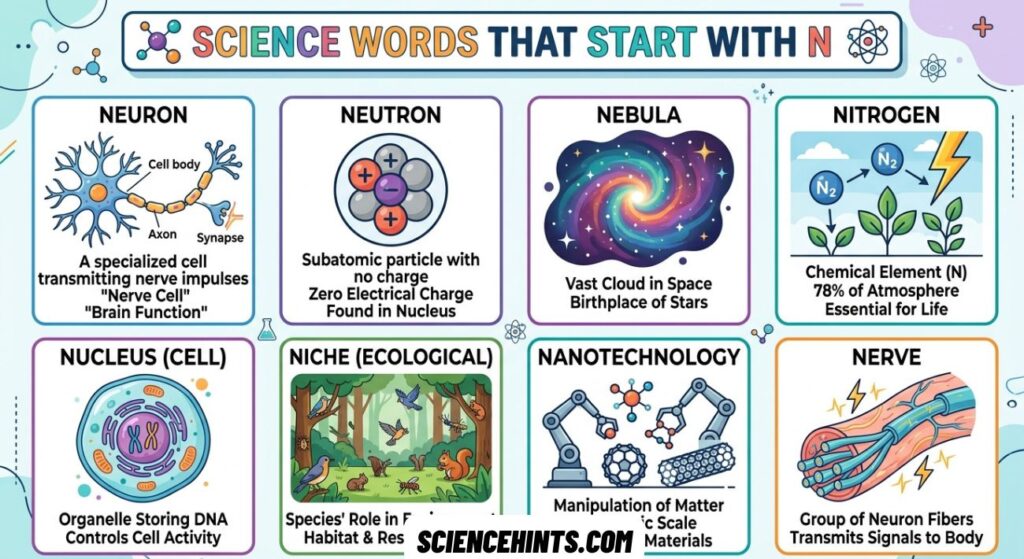
Words are the first step in understanding any subject. For students building their science education, knowing specific terms like “nucleus” or “neutron” turns textbook symbols into real-world ideas. This knowledge is essential for deep science learning and doing well in school.
For teachers, writers, and ESL learners, having a strong scientific terminology base is a superpower. It makes explaining complex topics much easier. This educational science resource acts as a bridge, connecting simple science facts for students with the more precise language used in professional science reference materials.
Physics Science Words That Start With N
Physics helps us understand motion, energy, and the basic laws of the universe. These physics terms beginning with N cover the invisible world of forces and particles that make up our reality.
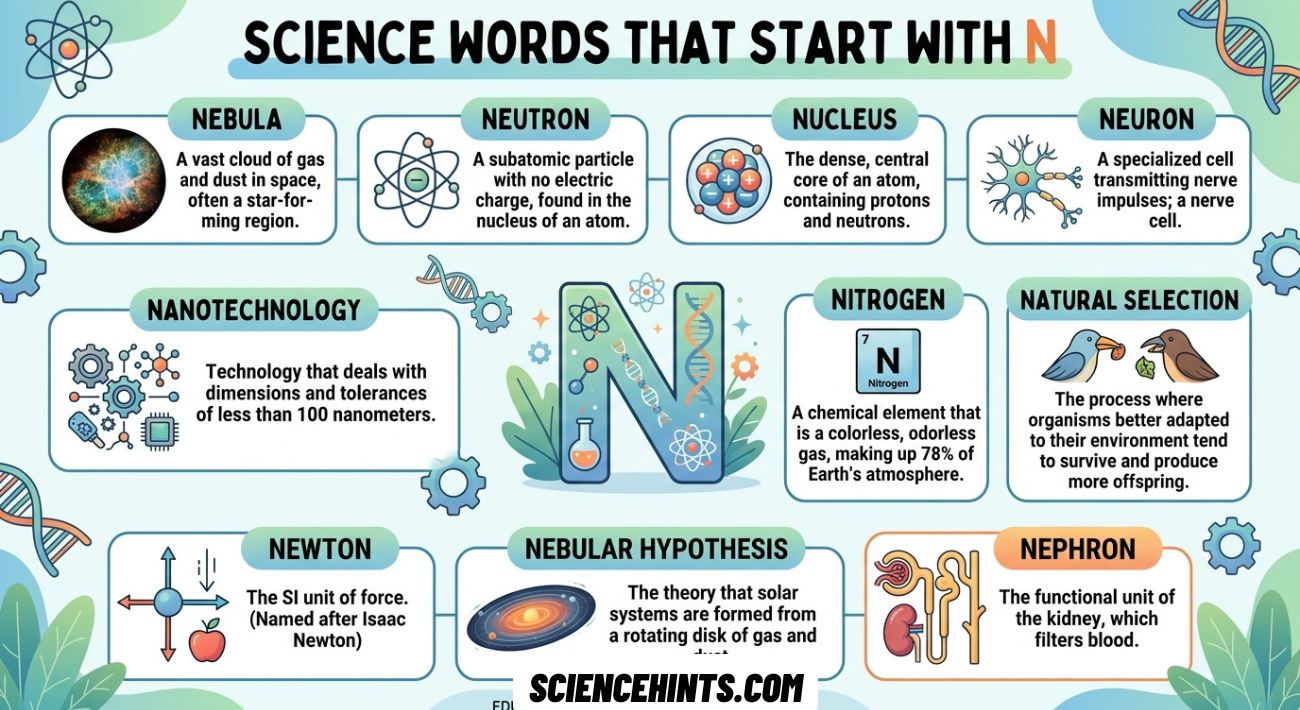
- Neutron – A tiny particle with no electric charge found in the center of an atom.
- Newton – The standard unit used to measure force.
- Nucleus – The extremely dense central core of an atom holding protons and neutrons.
- Normal force – The support push from a surface that stops an object from falling through it.
- Net force – The total sum of all pushes and pulls acting on an object.
- Nanometer – A unit of length equal to one billionth of a meter, often used to measure light waves.
- Node – A fixed point on a standing wave where there is no movement.
- Nozzle – A shaped tube designed to control the direction and speed of a fluid flow.
- Nuclear energy – The powerful energy stored in the center of an atom, released during reactions.
- Nuclear fission – The splitting of a heavy atomic nucleus into smaller parts, creating massive energy.
- Nuclear fusion – The joining of two light atomic nuclei to form a heavier one, the process powering stars.
- Neutrino – An almost massless ghost particle that rarely interacts with regular matter.
- Nonlinear dynamics – The branch of physics studying systems where small changes can cause chaotic results.
- N-type semiconductor – A material engineered to have extra free-moving electrons for electrical conductivity.
- Negative charge – The type of electric charge carried by electrons.
- Natural frequency – The speed at which an object vibrates freely when disturbed.
- Null – A condition in physics where a measurement or value is exactly zero.
- Near point – The closest distance your eye can see an object clearly.
- Nebula – (See Astronomy) A giant cloud, but studied in physics for its plasma dynamics.
- Nuclide – A specific type of atom defined by the exact number of protons and neutrons in its core.
Chemistry Science Words That Start With N
Chemistry explores what stuff is made of. These chemistry words starting with N focus on elements, reactions, and the naming rules that keep the chemical world organized.
- Nitrogen – A colorless, odorless gas that makes up about 78% of Earth’s air.
- Neon – A bright, glowing noble gas often used in colorful advertising signs.
- Noble gas – A group of very stable elements that rarely react with other chemicals.
- Neutralization – The safe reaction where an acid and a base cancel each other out to make salt and water.
- Nonmetal – An element that is poor at conducting heat and electricity, and is usually brittle.
- Nitrate – A natural chemical compound containing nitrogen and oxygen, vital for plant fertilizer.
- Nitrile – An organic chemical compound containing a carbon triple-bonded to nitrogen.
- Nucleophile – A chemical species that donates an electron pair to form a new bond.
- Nascent – Describes an element just freed from a compound, making it highly reactive for a moment.
- Nomenclature – The official rulebook system used for naming chemical substances.
- Nylon – A strong, synthetic, silk-like polymer plastic used in fabrics and ropes.
- Nonpolar molecule – A molecule with a balanced electric charge distribution, repelling water.
- Neutron activation – A process that makes stable materials radioactive by exposing them to neutrons.
- Nucleation – The very first step where atoms clump together to form a crystal or bubble.
- Nitrogen cycle – The natural recycling process moving nitrogen through the air, soil, and living things.
- Nitro group – A combination of nitrogen and oxygen atoms that makes a compound highly reactive.
- Naphtha – A flammable liquid mixture from petroleum used as a raw material for plastics.
- Neutral atom – An atom that has an equal count of protons and electrons, carrying no overall charge.
- Nanoparticle – A super tiny particle of material measured on the nano scale, often used in medicine.
- Nitrogen fixation – The process of turning inactive nitrogen gas from the air into useful ammonia.
Biology Science Words That Start With N
Biology is the study of living things. These biology words that start with N cover the tiny building blocks of life, the systems that keep us alive, and the rules of nature.
- Nucleus – The control center of a cell that holds the genetic blueprints.
- Nucleolus – A small, dense sphere inside the cell nucleus responsible for making ribosomes.
- Neuron – A specialized nerve cell that transmits information using electrical and chemical signals.
- Nerve – A cable-like bundle of fibers that carries impulses between the brain and the body.
- Natural selection – The natural process where organisms best adapted to their environment survive to reproduce.
- Niche – The specific job or role a species plays in its ecosystem, like how it eats and lives.
- Nucleic acid – The large biomolecule chain, like DNA or RNA, that stores life’s essential information.
- Nucleotide – The basic single building block or monomer that chains together to make DNA.
- Nephron – The tiny, functional filtering unit inside the kidney that cleans the blood.
- Nutrient – A substance that provides the raw materials needed for growth, energy, and repair.
- Nectar – A sugary liquid produced by flowers to attract pollinating insects and birds.
- Nymph – An immature stage of insects like grasshoppers, which looks like a small adult.
- Nosocomial – A term describing infections that originate within a hospital environment.
- Notochord – A flexible, rod-shaped body found in the embryos of all chordate animals.
- Natural immunity – Body protection against disease that is present from birth without prior exposure.
- Nastic movement – A non-directional plant movement in response to a stimulus, like a leaf folding.
- Neoteny – The retention of juvenile physical features into the adult phase of an organism.
- Nucleoplasm – The thick, jelly-like fluid held inside the nuclear membrane of a cell.
- Neurobiology – The specific branch of science dedicated to the anatomy and function of the nervous system.
- Nidification – The process and skill of building a nest.
Astronomy & Space Science With N
Space is full of wonder and mystery. These astronomy terms with N help us describe the massive objects and events happening far beyond our planet.
- NASA – The United States space agency responsible for the civilian space program and research.
- Nebula – A vast, beautiful cloud of gas and dust in space where new stars are often born.
- Neutron star – The super-dense, collapsed core of a giant star that exploded as a supernova.
- Neptune – The eighth, icy-blue gas giant planet from our Sun in the solar system.
- Nadir – The point in the sky directly underneath an observer, opposite the zenith.
- Nucleosynthesis – The cosmic process that creates new atomic nuclei from pre-existing protons and neutrons.
- Neutrino astronomy – A branch of astronomy that uses ghost-like particles to see into hidden parts of the universe.
- Nova – A sudden, bright flare-up on a white dwarf star caused by a nuclear explosion.
- Natural satellite – A celestial body that orbits a planet; a moon.
- Nereid – A small, distant moon of Neptune with a highly irregular orbit.
- Noctilucent cloud – Shiny, night-shining clouds visible in deep twilight, high in Earth’s atmosphere.
- Nadir point – The specific ground location directly under a satellite as it flies overhead.
- Near-Earth Object – A space rock or comet that has an orbital path bringing it close to Earth.
- Newtonian telescope – A reflecting telescope design invented by Sir Isaac Newton using a curved mirror.
- Nebular hypothesis – The widely accepted theory that solar systems form from a rotating cloud of gas.
- North Star – The bright star Polaris, located nearly directly above Earth’s North Pole.
- Non-gravitational force – A push, like outgassing on a comet, that changes its path besides gravity alone.
- Naked-eye astronomy – The practice of observing celestial objects without telescopes or binoculars.
- Nucleocosmochronology – The method of dating very old astronomical objects by studying radioactive decay.
- Nova remnant – The expanding shell of glowing gas left behind after a nova explosion fades.
See Also : 300+ Science Words That Start With S
Earth & Environmental Science Words Starting With N
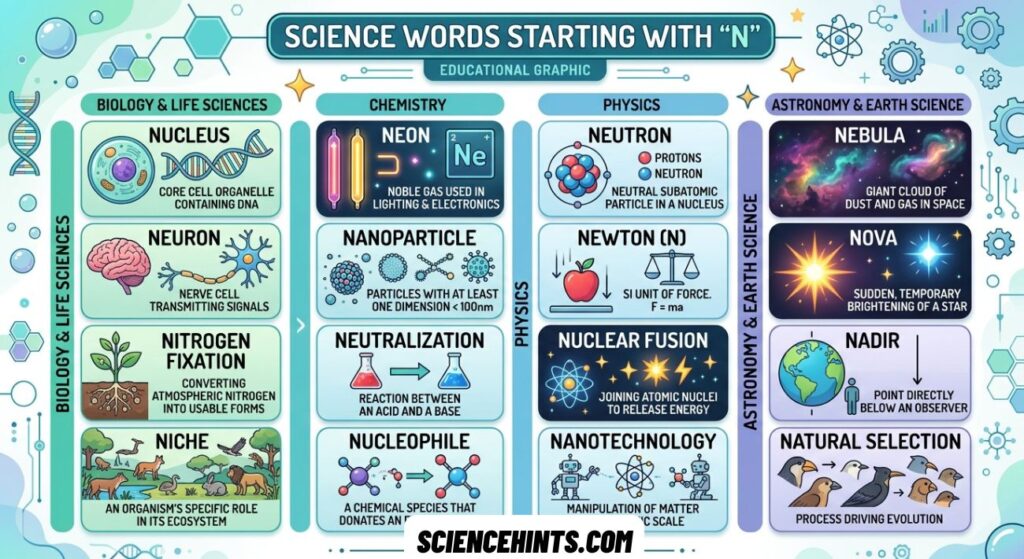
Our planet is a complex, living system. These earth science words starting with N and environmental science vocabulary terms cover weather, soil, water, and how we interact with nature.
- Natural resource – A raw material or energy source found in nature that is useful to humans.
- Nimbus – A dark, rain-filled cloud type that produces steady precipitation.
- Neap tide – The lowest high tide level, happening when the sun and moon pull at right angles.
- Nitrogen cycle – The circular pathway of nitrogen changing forms through the air, soil, and water.
- Nitrification – The soil bacteria process that converts ammonia into plant-usable nitrates.
- Non-renewable energy – Power sources like coal and oil that cannot be easily replenished in a short time.
- Natural hazard – An extreme natural event, like an earthquake or flood, that can threaten people.
- Nutation – A slow, rhythmic wobbling movement in the axis of a planet like Earth.
- Nival zone – The high-altitude geographical area on mountains covered by permanent snow.
- Nonpoint source – Pollution that comes from many spread-out sources, such as farm runoff or city streets.
- Natural levee – A raised bank of sediment built up alongside a river by years of flooding.
- Niche construction – The process where an organism changes its own local habitat to survive better.
- Neutral soil – Soil that has a pH value of exactly 7, neither acid nor base.
- No-till farming – A conservation farming method where the soil is not turned over before planting.
- Nutrient pollution – A harmful water problem caused by too much nitrogen and phosphorus running into water bodies.
- Numerical weather prediction – Using powerful computer math models to forecast the weather.
- Net primary productivity – The speed at which plants store leftover energy as tissue after breathing.
- Natural attenuation – The natural cleaning process that reduces pollution in soil or groundwater without human help.
- Nephelometric – A way of measuring water clarity by checking how much light scattered by particles.
- Nudation – The very first step in ecological succession when a bare land area is exposed.
Medical & Health Science Words That Start With N
The world of medicine uses precise words to describe the body and healing. These medical science words beginning with N are central to understanding health, the brain, and modern treatments.
- Neuroscience – The overall scientific study of the structure, chemistry, and function of the nervous system.
- Neurology – The specific medical field dealing with diseases and disorders of the brain and nerves.
- Neuron – A single, specialized nerve cell that is the basic working unit of the brain.
- Neuroplasticity – The amazing ability of the brain to rewire and form new connections throughout life.
- Neurotransmitter – A brain chemical messenger that signals between neurons, like dopamine or serotonin.
- Neurogenesis – The biological process of growing new nerve cells in the brain.
- Neurophysiology – The study of the electrical and physical functions of nerve cells and networks.
- Narcotic – A potent drug that blocks pain signals and induces drowsiness or sleep.
- Nausea – The uneasy, sick feeling in the stomach that often comes before throwing up.
- Nasogastric tube – A soft plastic tube inserted through the nose, down the throat, and into the stomach.
- Necrosis – The premature, unplanned death of living body tissue or cells.
- Neoplasm – An abnormal, uncontrolled mass of new tissue growth; a tumor.
- Nephrology – The branch of internal medicine focused on the study and care of kidneys.
- Nephron – The microscopic structural and functional blood-filtering unit of the kidney.
- Nanomedicine – The cutting-edge use of tiny nanotechnology tools for the prevention and treatment of disease.
- Neuralgia – A sharp, shocking nerve pain that follows the path of a damaged nerve.
- Nutrient – A chemical substance an organism needs to maintain life, grow, and produce energy.
- Neurotransmission – The entire process of signals chemically jumping across the gap between two nerve cells.
- Neonatology – The hospital specialty focused on the medical care of newborn babies, especially the sick.
- Narcolepsy – A chronic sleep disorder causing overpowering daytime drowsiness and sudden sleep attacks.
Technology & Applied Science Words With N
Technology turns science into useful tools. These technology science terms explain the digital, mechanical, and engineering concepts shaping our future.
- Nanotechnology – The engineering of functional systems at the microscopic molecular scale.
- Nanoelectronics – The branch of tech focused on creating super tiny electronic parts and transistors.
- Network – A linked group of computers or devices that can share data and resources.
- Neural network – A computer system loosely modeled on the human brain, designed to recognize patterns.
- Node – A single connection point or device within a larger digital or mechanical network.
- Natural language processing (NLP) – AI technology that helps computers understand and respond to human speech.
- Nanomaterial – A material with structural parts smaller than 100 nanometers in at least one dimension.
- Noise – Any unwanted random signal or data that interferes with a clear transmission.
- Non-volatile memory – Computer storage that keeps its data safe even when the power is turned off.
- Normalize – Adjusting data values to a common scale without distorting the differences in ranges.
- Null – A special marker used in databases to indicate that a data value does not exist.
- NAND gate – A basic digital logic gate that outputs false only if all its inputs are true.
- Nested – A coding structure where one function or loop is placed fully inside another one.
- Native app – Software built specifically to run on one particular platform or device, like an iPhone app.
- Near-field communication – A short-range wireless tech enabling contactless data exchange, like phone payment taps.
- Nanosensor – A chemical or physical sensor built on the nano scale to detect single molecules.
- Nanobots – Tiny, theoretical robots measured in nanometers, designed to perform specific micro-scale tasks.
- No-code platform – A tool letting users create software applications through graphical drag-and-drop interfaces.
- Network topology – The physical or logical arrangement pattern of the links and nodes in a network.
- Non-linear editing – Digital video or audio editing allowing random access to any frame at any time.
Easy Science Words That Start With N
Just starting your journey? These science vocabulary for kids and beginners are the perfect foundation. This easy science words set makes science facts for students simple to remember.
- Nest – A structure that birds and insects build to hold eggs and raise young.
- Nose – The body part used for smelling, breathing, and tasting flavors.
- Night – The dark period of a day when the sun is below the horizon.
- Nut – A dry fruit with a hard shell and a single seed inside, like an acorn.
- North – The compass direction pointing toward the top of the Earth, towards the Arctic.
- Needle – A thin, pointed leaf found on pine trees and cacti.
- Nectar – The sweet, sticky juice made by flowers to feed bees and butterflies.
- Neck – The narrow part of the body connecting the head to the shoulders.
- Nail – The hard, protective flat plate growing at the tips of human fingers and toes.
- Navy – A very dark shade of the color blue, often associated with deep water.
- Numbers – Math symbols used to count, measure, and label quantities.
- Nine – The whole cardinal number coming right after eight and before ten.
- Nickel – A shiny, silvery-white hard metal often used in coins.
- Net – A material made of crossed threads with holes, used for catching fish or insects.
- Nimbus cloud – A dark, gray cloud that brings rain or snow.
- Natural – Something that exists in nature, not made or caused by humans.
- Noon – Twelve o’clock exactly in the middle of the day.
- New moon – The moon phase where it is totally invisible because the dark side faces Earth.
- Nosebleed – A sudden loss of blood from the tissue lining inside the nose.
- Nap – A short, light period of sleep, usually taken during the daytime.
See Also : 300+ Science Words That Start With W
Advanced & Technical Science Words With N
Ready for a challenge? These advanced science terms are specialized definitions used in research papers and high-level scientific discoveries. They represent deep scientific definitions.
- Neuroplasticity – The lifelong capacity of the brain to reorganize synaptic pathways based on new experiences.
- Nanomedicine – The medical application of nano-scale materials for highly targeted drug delivery.
- Neuropsychopharmacology – The dense study of how drugs specifically affect the mind, brain, and behavior.
- Nucleosynthesis – The astrophysical creation of new heavy atomic nuclei from protons and neutrons.
- Non-Euclidean geometry – A type of geometry where curved space breaks the standard parallel line rules.
- Neutrino oscillation – The quantum phenomenon where a neutrino spontaneously changes its type mid-flight.
- Nanorobotics – The engineering discipline focused on creating machines at the scale of a molecule.
- Nuclear magnetic resonance – The physical phenomenon where nuclei absorb and re-emit radio waves in a magnetic field.
- Necroptosis – A programmed form of inflammatory cell death distinct from standard apoptosis.
- Null hypothesis – The default statistical assumption that there is zero relationship between variables.
- Nernst equation – A math formula calculating the exact voltage of an electrochemical cell under non-standard conditions.
- Neural crest – A temporary embryonic cell group that migrates to form facial bone and the peripheral nervous system.
- Nanoindentation – A precise method for testing the mechanical hardness of a material on the nanoscale.
- Non-Newtonian fluid – A liquid like oobleck or ketchup whose thickness changes sharply under sudden stress.
- Nucleocapsid – The tightly bound complex of the viral protein coat and the nucleic acid genome inside.
- Nuclear lamina – A dense fiber network inside the cell nucleus that provides mechanical support and shape.
- Non-coding RNA – A functional RNA molecule that is never translated into a protein.
- Neutron activation analysis – A very sensitive technique for identifying exact elemental composition traces.
- Nanoimprint lithography – A simple stamping process for creating nano-scale circuit patterns on a surface.
- Neuroethics – The modern ethical philosophy dealing with brain manipulation, scans, and consciousness.
Mathematics & Logic Science Words That Start With N
Math is the hidden language behind all science. These math terms link directly to scientific concepts and build a core part of any complete science dictionary words collection.
- Natural numbers – The simple counting numbers starting from 1, 2, 3, and going up infinitely.
- Negative number – Any number that is less than zero, shown with a minus sign in front.
- Numerator – The top part of a fraction that shows how many parts are being counted.
- Null set – A set in mathematics that contains absolutely no elements at all.
- Number line – A straight line where numbers are placed at equal spaces to show order and value.
- Nonagon – A flat, closed geometric shape that has exactly nine straight sides and nine angles.
- Normal distribution – A bell-shaped curve graph showing how data naturally clusters around an average.
- Notation – A system of written symbols and signs used to represent math and logic ideas.
- NAND – A logic operation that gives a false output only when all its inputs are true.
- Newton’s method – A clever math technique for finding better guesses to the roots of an equation.
- Nonlinear – A relationship on a graph that does not form a straight line but curves instead.
- Nominal – A scale of data used just for naming or labeling categories without any order.
- Nested loop – A loop pattern in programming placed completely inside the body of another loop.
- Null hypothesis – The default logical assumption that there is zero effect or difference to measure.
- Nim – A classic logic game of strategy where players remove objects from distinct piles.
- Nonparametric – Statistical tests that do not assume data follows a strict bell-shaped normal curve.
- N-tuple – A fixed, ordered list or sequence of a specific number of elements.
- Negation – The logical operation that flips a true statement to false, and vice versa.
- Nine-point circle – A special circle in geometry that passes through nine key points of any triangle.
- Network theory – The mathematical study of graphs showing connections between nodes and edges.
Engineering & Mechanics Science Words With N
Engineering applies physics to solve real problems. These technical words show how scientific language turns raw materials into safe structures and powerful machines.
- Newtonian fluid – A liquid like water whose thickness or flow rate stays constant under any stress.
- Non-Newtonian fluid – A strange liquid like quicksand that changes thickness when you push or hit it.
- Normalizing – A heat treatment process for metal that relieves internal stress and refines the grain.
- Nanocomposite – A strong multiphase solid material where one phase has nano-scale dimensions.
- Nozzle – A precisely shaped spout or pipe designed to control the jet speed and direction of a fluid.
- Neutral axis – The invisible line inside a bent beam where the material experiences zero stress.
- Nondestructive testing – Inspection methods that check a part’s safety without breaking or cutting it.
- Negative feedback – A control loop where the system corrects errors by reversing the output direction.
- Nanomanufacturing – The scaled-up industrial production of materials and devices at the nano level.
- Nacelle – The streamlined outer casing or housing that covers an aircraft engine.
- Nut – A small, square or hexagonal metal block with a threaded hole to match a bolt.
- Nonferrous – Describing metals like aluminum or copper that contain absolutely no iron.
- Nip – The point of contact where two rotating rollers press tightly together.
- Notch – A deliberate V-shaped cut or indentation made in a material edge for a mechanical purpose.
- Non-drip – A paint or liquid coating formula designed to stick and not run down vertical surfaces.
- Nanotube – A tiny, super-strong cylindrical carbon molecule with amazing electrical properties.
- Nominal size – The commercial name or label size of a part, slightly different from its actual measurement.
- Null position – The balanced, neutral resting state of a control system with zero input signal.
- No-load speed – The maximum rotation rate of a motor when it spins freely without pushing anything.
- Non-sparking tool – Safety hand tools made of soft metals like brass to prevent dangerous sparks.
Psychology & Social Science Words That Start With N
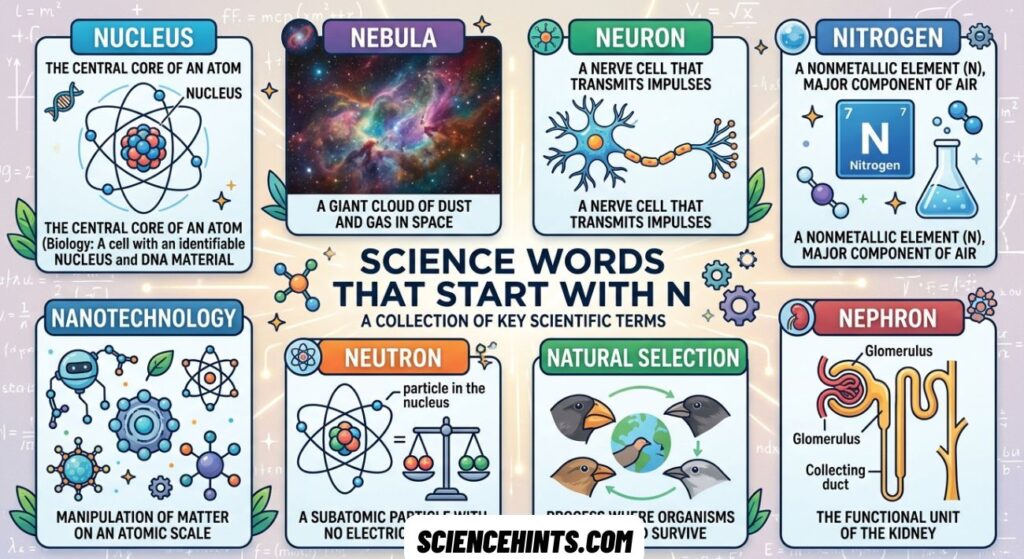
Human behavior is complex but measurable. These psychology terms blend academic science words with the study of the mind, fitting solidly in any scientific vocabulary list.
- Neuron – The single nerve cell that is the basic working block of the whole nervous system.
- Neurosis – A mild mental illness pattern involving chronic distress but not a break from reality.
- Nature – The influence of inherited genetic makeup on a person’s personality and behavior.
- Nurture – The impact of environment, upbringing, and social experience on shaping who we are.
- Neuroplasticity – The lifelong physical ability of the brain to reshape and rewire its own neural circuits.
- Neurotransmitter – A brain juice chemical like serotonin that floats across gaps to change our mood.
- Narcolepsy – A long-term brain disorder causing sudden sleep attacks during the waking day.
- Negative reinforcement – Removing a bad stimulus to increase the chance of a desired behavior repeating.
- Neurogenesis – The biological birth of fresh, new nerve cells in certain regions of the adult brain.
- Norms – The unwritten social rules and standards of expected behavior shared by a cultural group.
- Narcissism – An extreme self-centered personality trait marked by a deep need for admiration.
- Neuropsychology – The branch studying how specific brain injuries change behavior and thinking skills.
- NREM sleep – The deep, dreamless restorative sleep stages without rapid eye movements.
- Nociception – The raw sensory nervous system process of detecting a painful or damaging stimulus.
- Nonverbal communication – Sending silent social signals through body posture, face looks, and eye gaze.
- Naturalistic observation – A research method watching subjects quietly in their own natural habitat setting.
- Need hierarchy – Maslow’s famous pyramid theory ranking basic survival drives up to self-actualization.
- Negative symptoms – The absence of normal function, like flat emotion or social withdrawal, in schizophrenia.
- Neurofeedback – A brain training therapy where you watch your own brain waves to learn self-control.
- Negativity bias – The mental glitch where our brain pays more attention to bad news than good news.
See Also : 330+ Science Words That Start With F
Materials Science Words With N
Materials science invents the stuff our future is built from. These advanced terms describe the physical properties and atomic structure of solids, fibers, and smart surfaces.
- Nanomaterial – Any natural or synthetic substance with a grain size measured in the nanometer scale.
- Nanoparticle – A discrete ultrafine particle with all three external dimensions in the nano range.
- Nanotube – A tiny hollow pipe made of carbon atoms, stronger than steel and electrically conductive.
- Nanowire – A super-thin wire with a diameter the width of a virus, used for nano-scale circuits.
- Nanocomposite – A solid blend where nano-sized fillers are spread through a bulk matrix material.
- Nylon – The first totally synthetic thermoplastic fiber, known for its high tensile strength and shine.
- Neoprene – A family of synthetic rubbers resistant to oil, heat, and weather, often used in wetsuits.
- Nitinol – A smart metal alloy of nickel and titanium that can remember and return to its original shape.
- Nonwoven fabric – A flat textile made by bonding fibers together chemically or mechanically, not by weaving.
- Nucleation – The very first birth stage where tiny clusters of atoms form the seed of a new crystal.
- Normalizing – Heating steel above its critical point and air cooling it to make it soft and stress-free.
- Nitriding – A case-hardening process that diffuses nitrogen gas into the surface skin of a metal part.
- Non-destructive testing – A safety scan, like ultrasonic or X-ray, that checks a part without ruining it.
- Necking – The localized narrowing of a ductile metal rod right before it snaps under tension.
- Nanoporous – A solid structure filled with a sponge-like network of nano-sized holes and channels.
- Natural fiber – A plant or animal thread like cotton, silk, or flax, harvested directly from nature.
- Non-Newtonian fluid – A liquid material whose flow viscosity changes sharply under sudden shear force.
- Nanocoating – An ultra-thin protective surface layer applied to give glass, metal, or fabric new properties.
- Notch sensitivity – A measure of how much a surface scratch or notch weakens a material’s total strength.
- Network polymer – A plastic where molecular chains crosslink into a rigid 3D mesh, resisting heat and melting.
Food & Nutrition Science Words That Start With N
The science of food keeps us alive and healthy. These nutritional and food chemistry terms are perfect easy science words for beginners interested in diet and scientific concepts.
- Nutrient – A chemical in food that the body absolutely needs to grow, repair, and make energy.
- Nutrition – The total biological process of taking in food and using it for health and survival.
- Nitrogen – A tasteless gas vital for building plant proteins, often added to soil as a fertilizer.
- Nitrate – A natural salt form of nitrogen found in soil, leafy greens, and sometimes cured meats.
- Niacin – A crucial B vitamin that helps turn the food you eat into usable daily energy.
- Nectar – A watery sugar solution produced by glands inside flowers to attract pollinating birds and bees.
- Nutraceutical – A food product marketed to provide extra medical or health perks beyond basic nutrition.
- Non-GMO – A food label meaning the product was made without any genetically modified organisms.
- Natural flavor – A flavor extract derived directly from a spice, fruit, vegetable, or herb source found in nature.
- Nucleoprotein – A complex molecule made of nucleic acid and protein, consumed in high amounts in organ meats.
- Naringin – The bitter bioactive plant compound found in grapefruit peel responsible for its sharp taste.
- Nutrient density – The ratio of healthy vitamins and minerals packed in a food compared to its calorie count.
- Non-heme iron – The iron type found in plant foods like lentils and spinach, harder to absorb than meat iron.
- Net carbs – The total carbohydrate count minus the fiber and sugar alcohols, often tracked in keto diets.
- No-calorie sweetener – A sugar substitute that tastes sweet but adds virtually zero energy to the diet.
- Nanofood – Food products engineered or packaged using direct nanotechnology methods and tools.
- Nut allergy – A dangerous immune system overreaction to proteins found in tree nuts or ground peanuts.
- Nonessential amino acid – A protein building block the human body can make by itself without diet input.
- Nutrient absorption – The crucial transfer of digested food bits through the gut wall into the blood.
- Normal saline – A sterile saltwater solution matching body fluid concentration, used in medical drips.
Fun Facts About Science Words That Starting N
Science words have amazing backstories. These fun tidbits will make you see your science glossary A to Z in a whole new light and add depth to your science learning guide.
- Nitrogen vs. the Bends: Deep-sea divers breathe compressed air. If they surface too fast, nitrogen bubbles form in the blood, causing the painful “bends.” That’s why they use special gas mixtures and ascend slowly.
- Neptune was a Math Prediction: The planet Neptune was the first celestial object found purely by mathematical prediction. Scientists observed weird wobbles in Uranus’s orbit and calculated exactly where a hidden planet had to be.
- Neutron Stars are a Sugar Cube Nightmare: A neutron star is so dense that just one sugar cube-sized piece of it would weigh about 1 billion tons on Earth—as heavy as a mountain.
- Your Brain is a Construction Site: Neuroplasticity destroys the myth that your adult brain is hardwired. Every time you practice a skill or think a new thought, you are physically altering your brain’s structure.
- Noble Gases Were Shy: The noble gases were called “inert” for so long because scientists couldn’t force them to react. It wasn’t until 1962 that Neil Bartlett tricked Xenon into making a compound.
- The Naming of DNA: The word nucleic acid comes from the nucleus, where it was first found, but the acid part comes from its chemical nature. It’s actually a string of acidic sugar molecules holding the blueprint of life.
- Nanotechnology Mimics Nature: A nanoparticle is not a human invention first. The tiny, self-cleaning hairs on a lotus leaf and the sticky feet of a gecko both use nanostructures perfected by evolution.
Frequently Asked Questions
What stands for N in science?
In science, N can stand for Nitrogen, the chemical element with atomic number 7. It also represents the newton, the SI unit of force in physics.
What are 10 words that start with N?
Ten words that start with N are neutron, nucleus, neuron, nitrogen, nebula, nutrient, nitrate, neon, niche, and nanotechnology. These words are commonly used in different branches of science.
What are 10 science words?
Ten common science words are atom, cell, energy, force, gravity, molecule, neutron, nucleus, oxygen, and ecosystem. These terms help explain important scientific concepts.
What does the letter N stand for in science?
The letter N often stands for Nitrogen in chemistry and newton in physics. Its meaning depends on the scientific field and context.
Conclusion
Science Words That Start With N help students learn many important ideas in science. These words appear in biology, chemistry, physics, astronomy, and technology. Simple terms like nature, neuron, and nitrogen build a strong science vocabulary. Advanced words like nanotechnology and nucleosynthesis introduce new scientific concepts. Learning these words improves reading, writing, and classroom learning. It also helps students understand how the world and the universe work in a simple and clear way.
Learning Science Words That Start With N gives students more confidence in science every day. A strong vocabulary makes it easier to understand books, lessons, and experiments. These words also improve communication and critical thinking skills. Regular practice helps students remember new terms and use them correctly. Building science vocabulary step by step creates a solid foundation for future learning. Every new word brings more knowledge and makes science more interesting and enjoyable.